

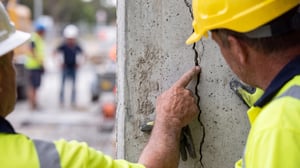
Early-Age Cracking: Thin Wall, Real Risk
Temperature monitoring is standard for thick foundations and large pours. For a normal wall, most teams skip it. Yet early cracking is well documented precisely in walls that are cast onto an already hardened base slab.
A typical sequence: the base slab has been finished for days or weeks. The wall is cast on top, usually without special precautions against thermal cracking, because it is not a massive element. The pour goes smoothly. In the days or weeks that follow, vertical cracks appear anyway, often through the full wall thickness. This is not an exception: early cracking in walls on slabs is a well-documented problem in practice.
In a basement, a tank or a treatment plant, every such crack is a potential leak and costly remedial work.
In this article we explain, in plain terms, why this happens, and why measuring the temperature is worth it even when the wall is thin.
Thin walls get warm, too
All concrete generates heat during cement hydration, not just massive pours. . The reason is hydration: when cement reacts with water, it releases heat. This reaction is strongest in the first hours and days after pouring. During that time, the temperature inside the wall rises well above the temperature the concrete was delivered at, and often peaks within the first few days.
How warm a wall gets depends on several factors:
- Wall thickness: The thicker the wall, the more heat stays inside and the higher the peak.
- Cement and mix design: A high cement content or fast-reacting cement produces more heat. Supplementary materials such as fly ash lower the peak and delay it.
- Formwork: Timber formwork and insulation hold the heat in and lead to higher temperatures.
- Fresh concrete temperature and weather: A warm start and high outdoor temperatures push the peak up even further.
That is why design guidelines also provide reference values for the expected temperature drop in walls, not only in mass concrete.
A thin wall still loses its heat faster than a thick foundation, and the difference between a warm core and a cool surface stays smaller. That is why it is often seen as harmless. But the heat itself is not the real problem. What matters is what happens when the wall cools down again while it is attached to a slab that has already hardened.
The real problem: the wall can't deform freely
Concrete responds to temperature changes with changes in length. During hydration, the young wall expands; as it cools afterwards, it contracts again. On top of that comes autogenous shrinkage: the concrete loses volume through the chemical reaction itself, even without drying out. A common rule of thumb is a coefficient of thermal expansion of about 10 × 10⁻⁶ per kelvin. A 10 m long wall that cools by 20 K therefore wants to shorten by around 2 mm.
If the wall could move freely, these deformations would cause no harm. In practice, however, it is connected along its entire bottom edge to a base slab that was usually cast days or weeks earlier. That slab has already gone through its own temperature cycle, is considerably stiffer and does not follow the wall's contraction.
The timing is what matters. During early heating, concrete is relatively compliant, so expansion may generate limited stress. During the cooling phase, it has already hardened. Now the slab restrains the contraction, and tensile stresses develop in the wall. Young concrete, however, has only a low tensile strength, which is itself still developing during these days. Once the tensile stress exceeds the current tensile strength, the wall cracks.
Engineers call this external restraint, and the resulting cracks restraint cracks. It differs from internal restraint, which occurs when the warm core and the faster-cooling surface want to deform by different amounts. In massive elements, internal restraint often dominates; in walls on base slabs, external restraint is usually the governing factor.
Restraint cracks in walls follow a typical pattern. They run mostly vertically, often as through-cracks across the full wall thickness, and concentrate in the lower half of the wall. They can appear within the first day, but also only weeks after the formwork has been removed, when cooling and shrinkage add up.
How strong the restraint is depends mainly on three factors:
- Stiffness ratio: The more massive and stiff the slab is compared to the wall, the more firmly it holds the wall.
- Geometry: Long, low walls are restrained over a larger part of their height than short, tall walls. The length-to-height ratio is therefore a key parameter.
- Construction sequence: The older the slab is when the wall is cast, the greater the difference in stiffness between the two.
It follows that the construction drawing does not tell the whole story. On paper, wall and slab form one element. On site, they are cast days or weeks apart, and gaps of several weeks are not unusual. How strongly the wall is restrained is determined by the order and timing of the pours, not by the final geometry alone.
This insight is not new. Even guidance on mass concrete and hot-weather concreting explicitly names a thin wall on a thick base slab as a case where temperature control matters. The reason is the high degree of restraint, not the amount of heat.
For engineers: With a degree of restraint R between 0 (free) and 1 (fully restrained), the restrained strain is roughly R × (α × ΔT + autogenous shrinkage). Real numbers show how quickly this adds up. In a monitored full-scale wall, the measured temperatures produced a thermal strain of 323 microstrain, and 353 microstrain once autogenous shrinkage was included. Depending on the calculation method, the degree of restraint for the same wall was estimated at about 0.72 to 0.82, with 0.8 used as a safe value. Early-age concrete can only accommodate a fraction of such strains in tension.
Why you can't see it coming without measuring
Thermal cracking risk develops early, although cracking may occur later, and none of it is visible from the outside. From the outside, the concrete looks the same whether its core is barely warm or close to its peak. A wall can look perfect when the formwork comes off and still crack days or weeks later. Some walls crack within the first day, others only weeks after the formwork has been removed. By the time a crack is visible, it is too late to change anything.
The planning usually assumes a certain concrete temperature, certain weather and a certain stripping time. On site, reality often looks different, and each deviation shifts the risk:
- The concrete arrives warmer than planned. On a summer afternoon or after a long delivery, the fresh concrete starts at a higher temperature. Hydration then reacts faster and the peak climbs higher. The higher the peak, the further the wall has to cool down later.
- The mix produces more heat than expected. A different cement batch, a higher cement content or a substituted product can change how much heat develops. On paper, nothing changed. Inside the wall, the peak is higher.
- The formwork comes off at the wrong moment. If the wall is stripped while its core is still warm, right before a cold night, the surface cools down suddenly while the inside stays warm. That creates additional stress between core and surface, on top of the restraint from the slab.
- The slab is older and stiffer than planned. Delays in the programme are normal on site. But every extra day or week between slab and wall means the slab is harder and holds the wall more firmly. The timing of the pours shapes the restraint, not just the final geometry.
Each of these deviations is small on its own and easily overlooked. Together, they can turn a wall that would have been fine on paper into one that cracks. Without temperature data, nobody notices. With it, the team sees what is happening inside the wall while there is still time to act.
Why test samples can be misleading
Traditionally, strength is checked with small test specimens (cubes or cylinders). They are made from the same concrete, stored nearby or in a lab, and crushed in a press. That sounds reliable, but there’s a catch: a small sample doesn’t experience the same temperatures as the real structure. The heat produced by hydration stays in a thick wall or slab for days, because the large volume holds on to it. A small test cube has far less mass and a much larger surface relative to its size, so it loses that heat almost immediately. The cube therefore hardens under different conditions, and its strength may not reflect what is actually happening in the structure.
As a result:
-
In normal or warm conditions, the real element is often stronger than the test sample suggests. Crews wait longer than they need to.
-
In cold weather, it can be the other way around. A sample stored in a heated lab looks fine, while the real slab on an exposed deck is still weaker than expected. That's the risky case.
There's also a practical problem. Specimens have to be made, stored, transported and tested, and the result arrives hours or days later. By then, the decision on site has often already been made. And a single specimen represents one sample of concrete, not the edge of a slab that was exposed to wind all night. The maturity method complements conventional testing with in-place strength estimates and it delivers the result continuously instead of on the next lab day.
Even the best calculation is only as good as its inputs
Crack-control calculations exist, but they rely on assumptions about temperature and restraint, and those are hard to get right. Measured temperatures replace the biggest guess with a fact.
Design methods from Europe, Australia, Japan and the US, including Eurocode 2, CIRIA C766 and ACI guidance, can predict noticeably different crack widths and reinforcement needs for the same wall. When calculations are compared with real structures, an underestimated imposed strain and a misjudged restraint are among the main reasons why predicted and actual cracking differ.
Computer models do not escape this either. A detailed simulation still needs to know the concrete temperature at delivery, how much heat the mix produces and when the formwork comes off. More detail in the model means more assumptions that have to be right. If those inputs are off, a convincing colour plot can still be wrong.
Temperature monitoring closes that gap. It shows what the concrete actually did, so the assumptions behind the calculation can be checked against reality, during the pour and for the next one.
What temperature monitoring shows you
A few sensors in the right places are enough to make the invisible visible. They are fixed to the reinforcement before the pour, and the readings show up live in the web application.
| Sensor position | What you learn |
|---|---|
| Inside the wall, just above the slab, mid-length | How hot the wall gets where the crack risk is highest |
| Near the wall surface | Whether the surface cools much faster than the inside |
| In the slab, close to the wall | How warm the concrete is that holds the wall back |
| Outside air | What temperature the wall will cool down to |
| Upper part of the wall | How the temperature changes with height |
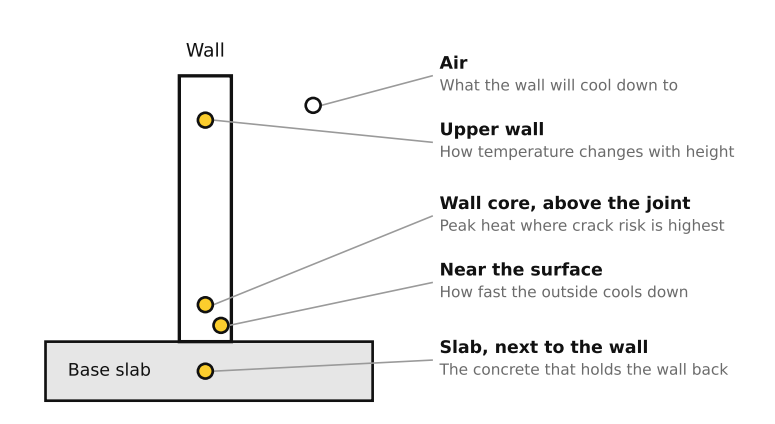
From these readings, three questions matter most:
-
How hot does the wall get? The higher the peak, the more the wall will shrink when it cools down.
- How fast does it cool down? A slow, steady cool-down is gentle. A sudden drop, for example after early stripping, is dangerous.
- How big is the gap between inside and surface, and between wall and slab? Large temperature differences can increase cracking risk under restraint.
With mix-specific calibration, the same data can estimate concrete strength using maturity. So one measurement answers two questions: is the wall strong enough, and is it cooling safely?
For engineers: Allowable temperature differences and cooling rates are project-specific and should come from the design, the specification or a thermal analysis. The measured curves show whether the pour stays within those limits and let you check the assumptions in your crack-control calculation, especially the peak temperature and the temperature drop ΔT.
With TEMO , TEMO Link or ISC Link you can follow all of this from the office or your phone, around the clock.
Reading the temperature curve
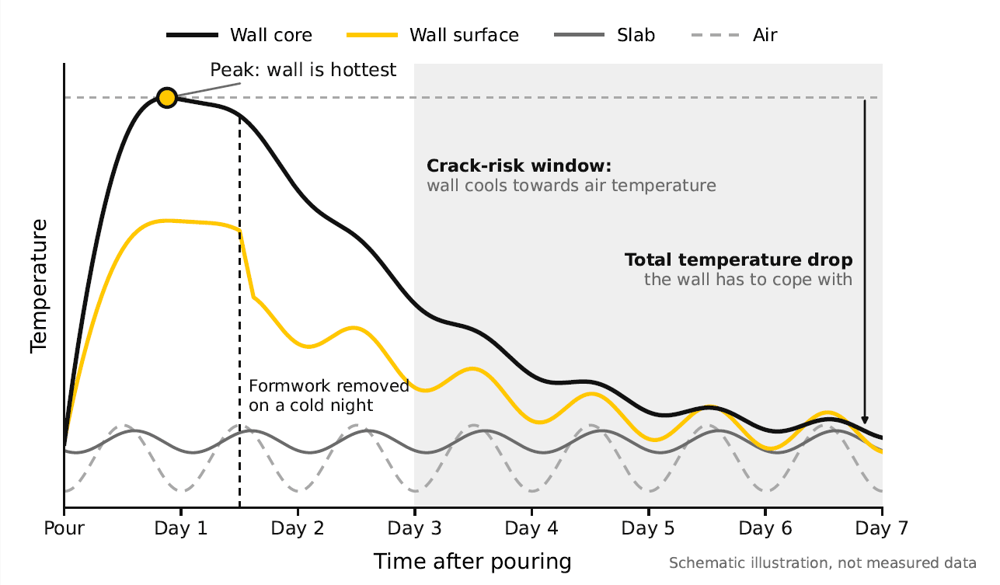
The black line shows the core of the wall. Within the first day, it climbs to its peak, well above the temperature of the slab (dark grey) and the outside air (light grey, dashed). The yellow line shows the wall surface. It stays cooler than the core, and when the formwork comes off on a cold night, it drops sharply. This sudden gap between core and surface creates additional stress in the concrete.
From around the third day, the wall enters the critical phase (grey shaded area). By now it has hardened, and it keeps cooling towards the air temperature while the slab holds it in place. The arrow on the right shows the total temperature drop from the peak. The larger this drop, the more the wall wants to shorten, and the higher the risk of restraint cracks.
The chart is a simplified illustration. On a real site, the shape of the curves, the height of the peak and the timing depend on the mix, the wall thickness, the formwork and the weather. That is exactly what the sensors measure.
What you can do with the data
Measuring only pays off if it leads to better decisions. The good news: most of them are simple and cheap.
While the wall is hardening
- Use temperature and verified strength data to inform safe formwork removal.
- Leave the formwork on longer, or cover the wall, if it is cooling down too quickly.
- Avoid stripping right before a cold night.
For the next wall
- Compare the measured temperatures with what was planned. If the wall got hotter, adjust the mix, the delivery time or the pour size.
- Use the first wall as a benchmark. On large projects with many similar walls, this pays off again and again.
If a crack appears anyway
- The temperature record shows what the concrete actually went through. This provides useful evidence when investigating the causes of cracking.
Extra reinforcement can keep cracks narrow, but it does not stop the wall from wanting to shrink. Controlling the temperature tackles the problem at its source.
Established guidance on crack control follows the same logic. First reduce how much the wall wants to move, through the mix, the placing temperature, insulation or cooling. Then reduce how firmly it is held, through pour length, sequence or joints. Reinforcement comes last, to control the cracks that remain. Where the design cannot change, more bars of a smaller diameter keep cracks narrower than fewer large bars. In every one of these steps, temperature data shows whether the measure is working.
Which walls should you monitor?
Some walls are more prone to restraint cracking than others. The risk rises when several unfavourable conditions come together. The more of the following points apply to a wall, the more important temperature monitoring becomes, even if the wall is thin:
- The wall is cast onto a slab or foundation that is already days or weeks old. The older the slab, the stiffer it is and the more firmly it holds the young wall. This is the classic case in which early cracks occur in practice.
- The wall is long compared to its height. A long, low wall is held back by the slab over a large part of its height. A short, tall wall can move more freely in its upper part. The length-to-height ratio is therefore one of the key factors for how strongly a wall is restrained.
- The wall has to be watertight. In basements, tanks, underground car parks or treatment plants, even fine through-cracks can let water in. Sealing them afterwards is costly and disrupts the programme.
- The pour takes place in warm weather or with a high-heat cement. Both raise the peak temperature, and with it the temperature drop the wall has to cope with later.
- Early stripping is planned, or cold nights are forecast. A sudden drop in surface temperature adds stress between core and surface. Temperature data shows when stripping is safe.
- The wall is enclosed by existing walls or corners on several sides. Restraint then comes not only from below but also from the sides, which leaves the wall even less room to move.
Since walls are usually cast in a separate step after the slab, the first point alone applies to many walls on a typical construction site. That is why temperature monitoring is worth considering far more often than the label "mass concrete" suggests.
Conclusion: thin doesn't mean safe
Whether a wall cracks does not depend on its thickness alone. It depends on how much it heats up, how fast it cools down, and how firmly it is held in place. You cannot see any of this from the outside, but you can measure it.
Monitoring can cost significantly less than repairing a leaking crack. That is why temperature monitoring makes sense not only for mass concrete, but for every wall with a high crack risk.
Want to learn more? Read about challenges in massive concrete components and hot weather concreting.
Planning a wall pour? Find the right setup with our Solution Finder, or book a 20-minute demo with our team.
References & Standards
- Jędrzejewska, A., Zych, M., Torrenti, J.M., Kanavaris, F., Azenha, M., Chen, F. & Ito, S. (2024). Practical insights on standardised models for estimation of crack width due to imposed strains in edge-restrained reinforced concrete elements. Engineering Structures, 305, 117757.
- Bamforth, P. (2018). CIRIA C766: Control of cracking caused by restrained deformation in concrete. CIRIA, London.
- DIANA FEA. Staggered Structural–Heat Flow Analysis of Early Age Concrete. Tutorial documentation.
- EN 1992-1-1, Eurocode 2: Design of concrete structures, section on crack control and minimum reinforcement.
- Jędrzejewska, A., Kanavaris, F., Zych, M., Schlicke, D. & Azenha, M. (2020). Experiences on early age cracking of wall-on-slab concrete structures. Structures, 27, 2520–2549.
- El Khoury, K., Ridley, I., Vollum, R., Forth, J. et al. (2023). Experimental assessment of crack prediction methods in international design codes for edge restrained walls. Structures, 55, 1447–1459.
- Gupta, R. & Kuder, K. (2014). Effect of Formwork, Wall Thickness, and Addition of Fly Ash on Concrete Hydration. Advances in Civil Engineering Materials, 3(1), 479–494.
- Rathnayaka, H.P., Dasanayake, D.K.A.M.P. & Yapa, H.D. (2022). Assessment of Time-dependent Temperature Behaviour in Immature Concrete Walls using Numerical Analysis. Engineer: Journal of the Institution of Engineers, Sri Lanka, 55(1), 49–61.
Curious about concrete performnce monitoring?
We will present the Vemaventuri solution to you in a 20-minute online demo without any obligation.

