


Skip to content

The second generation of Eurocode 2 introduces a paradigm shift from prescriptive recipes to performance-based concrete design. However, this transition opens a critical verification gap: key calculations now rely on real-time parameters—such as hydration temperature, strength maturity, and the actual water-cement (w/c) ratio—that must be measured on site rather than assumed at a desk. This guide explores how Vemaventuri’s advanced real-time sensor technology bridges this gap directly in your specifications (LV), enabling engineers and contractors to turn design assumptions into documented facts and effortlessly master Eurocode 2 compliance.

What Is Eurocode 2?

Eurocode 2 (standard designation EN 1992) is the European standard that concrete structures are designed to. It governs how thick a slab has to be, how much reinforcement goes into it, and how much concrete cover has to protect that reinforcement so that it does not begin to corrode over the structure's design service life. 

It does not stand alone. It sits in a chain of three standards, and that division of labour explains the whole topic:

  • EN 1992 (Eurocode 2) states what the structure must be.
  • EN 206 states what properties the concrete must have to deliver it.
  • EN 13670 states how the site must work so that the two meet.

This is deliberate. The foreword to EN 1992-1-1:2023 states that the Eurocodes are to be applied together with the relevant execution, material, product and testing standards, and that they identify the requirements for execution, materials, products and testing that they rely upon.

In other words: the design makes assumptions about the concrete and about the way it is placed. If those assumptions do not hold on site, the calculation no longer describes the structure that was built, even when the finished element looks entirely normal.

What Changed?

A substantially revised edition of Eurocode 2 was published at the end of 2023. It must be given national standard status by September 2027, and conflicting national standards will be withdrawn by March 2028. Both generations coexist until then. The most consequential change is not that there is more calculation, but how the calculation works. In several places the new edition replaces tabulated values with models that represent actual properties. Durability, for instance, now has an explicitly performance-based design method, built on exposure resistance classes rather than prescriptive limits alone. That is more precise, but only if the values fed into the models are correct.


Topic First generation (EN 1992-1-1:2004) Second generation (EN 1992-1-1:2023)
Durability Structural classes and tables: exposure class plus adjustments give the minimum cover Exposure resistance classes in clause 6.4 classify concrete by its resistance to carbonation and chloride ingress. The former approach is retained as an alternative in the informative Annex P
Time dependent behaviour (strength development, creep, shrinkage) Split across the document: strength development in the main text, creep and shrinkage in the informative Annex B Consolidated in the normative Annex B, with clause B.4 on the development of concrete strength and stiffness with time. Creep and shrinkage models updated and unified for normal and high strength concrete
Early age cracking No general assessment method in the main text. Restraint cracking was covered largely through minimum reinforcement, with specific provisions only in EN 1992-3 for containment structures New informative Annex D provides a method for assessing restraint cracking risk, including clause D.4 on the assessment of temperature history


And that is where the gap opens. All three of these rely on values that are not determined at a desk. They are determined on site. How warm the concrete got while it hardened. How much water was actually in it. Whether the section was genuinely consolidated all the way through. Until now, nobody measured them. They were assumed.

Also changed, though mainly for the design office: the three former standards for buildings, bridges and containment structures are merged into one, with bridges now in the normative Annex K and water tightness in Annex H. Ultimate limit state models for confined concrete, shear, punching and strut and tie were updated with size effect considered where relevant, and anchorage and lap provisions were reworked around non linear bond. The material scope was extended to concrete class C100, reinforcing steel B700 and prestressing strand Y2060, and now covers stainless reinforcement in the normative Annex Q and embedded FRP reinforcement in the informative Annex R. Assessment of existing structures and strengthening with CFRP arrive in the informative Annexes I and J, steel fibre reinforced concrete in Annex L and recycled aggregate concrete in Annex N.

Durability: From Recipe to Performance

Durability here means one thing above all: the reinforcing steel must not begin to corrode within the structure's design service life. Two processes threaten it — carbonation from CO₂ in the air, and chlorides from de-icing salt or seawater. Both have to travel through the concrete to get there.

Whether they travel fast or slowly is decided during the pour. Cement chemically needs only about a quarter of its weight in water. Everything beyond that is added for workability, does not react, and leaves a void behind as it dries out. The more surplus water, the more of these pores form and the better connected they are. They are the route inward. 

For carbonation and chloride ingress, permeability is the governing property. While many factors influence permeability, few can change on site as quickly and as significantly as the effective water-to-cement ratio at the time of placement.
 

What changes

Until now the code prescribed a recipe: maximum water to cement ratio, minimum cement content, minimum strength. The concrete cover followed from that.

The new edition turns this around. Clause 6.4 classifies concrete not by what it is made of but by its measured resistance — XRC classes against carbonation, XRDS classes against chloride ingress. No longer what the concrete consists of, but what it delivers.

The water to cement ratio no longer appears in that definition. This is not an oversight. It is the whole point of the performance approach.

Why this reaches the site

The class is determined on specimens in a laboratory, after 28 days. It describes a mix design, not a delivery.

Between that test and the concrete in the wall lie transport time, slump loss, and the oldest reflex in construction: adding water at the discharge point so the concrete can be placed. It is invisible in the finished surface and appears in no cube sampled beforehand.

The code is candid about this. Beneath its cover tables it states that the values assume execution and curing in accordance with EN 13670. Assume, not verify. How anyone is meant to show the condition was met is not addressed.

Vemaventuri Sensor Solution

Water Content & W/C Ratio Determination of Fresh Concrete

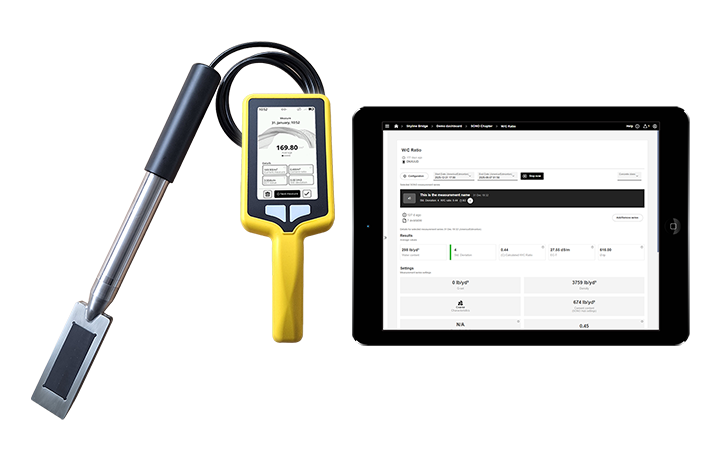
The Vemaventuri SONO system determines the water to cement ratio of fresh concrete at the discharge point, immediately before placement.

Eurocode 2 does not require this. It requires no measurement on site at all. What it requires is an outcome — and the water to cement ratio is the quantity that decides, at the point of pour, whether that outcome is still achievable.

The value therefore lies upstream of compliance, not in it. A load outside tolerance can be sent back. A wall cannot. The disagreement over how much water went in becomes a number instead of an argument, and it arrives while the concrete is still in the truck.
 

Time Dependent Behaviour: Strength Develops by Temperature, Not by Calendar

Concrete does not gain strength with time. It gains strength through hydration, the reaction between cement and water, and that reaction runs faster when it is warm and slower when it is cold.

Two walls from the same delivery, one poured on a February night in the open and one inside a heated enclosure, have measurably different strength after three days. The calendar says nothing about it. What does describe it is maturity: a calculated value combining time and temperature to estimate the strength currently present in the element.

What changes

The most consequential change here is easy to overlook. Under the first generation, 28 days was effectively fixed as the age at which concrete had to reach its specified strength. The second generation allows the reference compressive strength to be defined at any age between 28 and 91 days.

The reason is sustainability. Cement production is the dominant source of CO₂ in concrete, and the most direct way to reduce it is to use less clinker. Concretes with high proportions of slag, fly ash or limestone reach the same final strength, but they get there more slowly. Judged at 28 days they look weak. Judged at 56 or 91 days they are not. Allowing a later reference age removes a barrier that was pushing designers toward clinker-rich mixes.

Alongside this, time dependent material behaviour was consolidated into Annex B, which is now normative, with clause B.4 covering the development of concrete strength and stiffness with time. The creep and shrinkage models were updated and unified for normal and high strength concrete.

Why this reaches the site

A slower concrete does not only reach its final strength later. It passes every intermediate point later too, including the one that matters on site: the strength required to strike formwork, transfer prestress or load the element.

This is where experience stops helping. A site team knows how their usual C30/37 behaves after two days in April. With a low-clinker mix on a 56-day reference age, that intuition no longer applies, and the safe response is to wait longer than necessary. The environmental gain is real, and the schedule pays for it.

The models in Annex B describe how strength develops. What they cannot supply is the thermal history of the element, because that is not a property of the mix, it is a property of the pour. Nothing in the design office knows it.

Cubes do not close the gap either. A cube stored beside the element, or in a laboratory water bath, is a different size with a different surface to volume ratio and therefore a different thermal history. It confirms that the concrete delivered was compliant. It does not measure the concrete in the wall.

Vemaventuri Sensor Solution

Concrete Maturity Monitoring

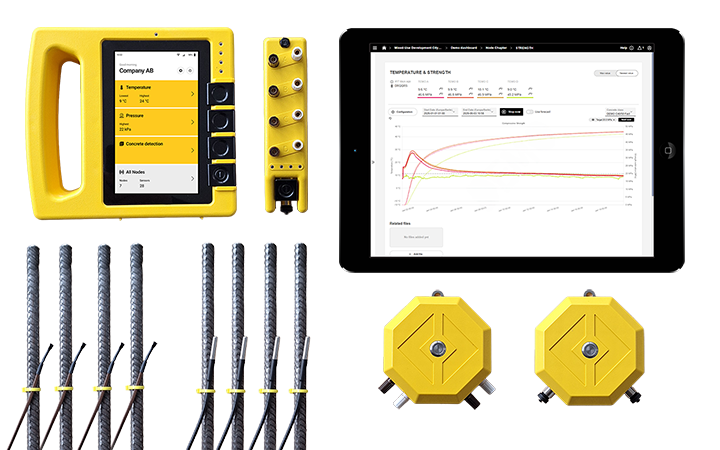
TEMO sensors are embedded at the governing depths and record temperature continuously, from placement to the end of curing. The system converts that record into a live estimate of the strength present in the element.

Vemaventuri offers three systems for this, depending on requirements and project scale: TEMO Link, ISC Link and Hub & Node. From a single element to a fully instrumented site, the measurement principle stays the same — only the setup changes.

Eurocode 2 does not require this. It requires no measurement on site at all. What it requires is an outcome — and with reference ages now extending to 91 days, the point at which that outcome is reached is harder to predict from experience than it used to be.

The value therefore lies in the schedule, not in compliance. Without data, formwork comes off when the programme says so, and the programme has to be conservative because nobody knows what the concrete is doing. With data, it comes off when the strength is there. On a repetitive structure that difference compounds across every cycle.
Early Age Cracking: The Crack That Comes Before Anyone Uses the Structure

Some cracks have nothing to do with load. They form in the first few days, while the concrete is still hardening, and they go straight through the wall.

Here is how it happens. Hardening produces heat, and the element expands. Then it cools and wants to contract again. Often it cannot, because it sits on a base slab that has already hardened. Anything that cannot contract goes into tension. And young concrete does not take much tension yet. Where it becomes too much, it cracks through.

On a car park wall that is a blemish. On a water-retaining basement or tank it is a defect that has to be injected, and someone pays for it.

What changes

The first generation had no general method for this. Restraint cracking was largely covered by prescribing minimum reinforcement, with specific provisions only in EN 1992-3 for containment structures. You did not assess the risk. You covered it.

The second generation adds Annex D, "Evaluation of early-age and long-term cracking due to restraint" — one of the scope extensions the European Commission's own workshop material lists among the key additions to the code. It provides a method to actually evaluate the risk.

And it is worth looking at how that method is built. Clause D.4 is "Assessment of temperature history", with D.4.2 covering material properties in relation to temperature development. Only then come D.5, stress calculations, and D.6, crack width calculations.

The order is the point. The temperature history is not an input among others. It is the first step, and everything downstream depends on it.

Why this reaches the site

Anyone applying Annex D has to assume a temperature curve. At the desk that is fine. But nobody there knows what actually happened on site.

The real curve depends on wind, on the overnight temperature, on the mix, on the formwork, on an unplanned gap between deliveries, on when the insulation came off. A 1.8 m raft poured on a windy day does not follow a standard curve.

And here is the difference from the other two topics. Carbonation shows up after twenty years. Strength can be tested. Early age cracking happens over about three days — and during those three days you can still intervene. Leave the insulation on longer, strike later, cool the section.

But that only works if you can see what is happening while it happens.

Vemaventuri Sensor Solution

Concrete Temperature Monitoring

TEMO sensors placed at the core, mid-section and near the surface record the temperature of the element simultaneously at every depth. That resolves both figures a specification usually caps: the peak temperature, and the difference between inside and outside. The web app plots the differential against a reference channel as a curve of its own, and reports the maximum ΔT reached as a value alongside the peak and minimum temperatures — so a specified gradient limit is read off directly instead of estimated from two overlapping lines. 

Three systems are available for this, depending on requirements and project scale: TEMO Link, ISC Link and Hub & Node. From a single critical pour to a fully instrumented site, the measurement principle stays the same — only the setup changes.

Nor does Eurocode 2 require this. Annex D is informative, and e.g. in Germany the National Annex keeps it that way. But the crack forms regardless, and the repair costs regardless.

The value here is the window. Carbonation shows up after twenty years and strength can be tested, but early age cracking happens over about three days — and during those days the outcome can still be changed. Insulation left on longer, striking delayed, cooling adjusted. That only works if someone can see the curve while it is forming.

Key Takeaways for Designers

Bridge the Eurocode 2 verification gap directly in your specifications (LV): By specifying continuous temperature monitoring, w/c verification, and real-time sensor technology as execution deliverables, you can easily satisfy the strict compliance requirements of Eurocode 2 while turning design assumptions into documented facts.

  • Your durability route is now a decision, not a default. Exposure resistance classes or Annex P — the National Annex governs, and e.g. in Germany the draft keeps Annex P normative. Check which applies before you specify a cover value.
  • Specifying a later reference age has consequences you do not control. Referencing strength at 56 or 91 days makes low-clinker concrete viable, and it pushes every intermediate strength later too. The contractor absorbs that in striking times you never see.
  • Whatever temperature curve you assume in Annex D becomes an execution requirement. Clause D.4 comes before the stress and crack width calculations. If the real curve deviates, your reinforcement layout was verified against a scenario that did not happen — and your name is on the calculation.
  • Your cover values are conditional. The tables assume placement, compaction and curing to EN 13670. If that is not written into the execution specification, the condition your design depends on is not contractually owed by anyone.
  • The gap is verification, not method. Eurocode 2 tells you how to calculate. It does not tell anyone how to demonstrate that the execution assumptions held. That gap sits with whoever gets asked first when something cracks.

References & Standards

  • European Commission, Joint Research Centre (2025) — The Second Generation Eurocodes: key changes and benefits through design examples. EN 1992 session, A. Pérez Caldentey. Online workshop, 3–5 June 2025. 
  • Andrade, C. & Izquierdo, D. (2023) — Durability and cover depth provisions in next Eurocode 2: background modelling and calculations. Hormigón y Acero 74(299–300), 19–40. Open access. 
  • Menga, A. et al. (2024) — Early-age cracking due to restraint: laboratory and field investigations on the predictive capacity of the simplified method in Annex D of the future EC2. Structural Concrete 25(6), 4300–4323. 
  • Kanstad, T., Klausen, A.B.E. & Menga, A. (2023) — Background document to FprEN 1992-1-1 Annex D. CEN/TC250/SC2/WG1/TG7. 
  • von Greve-Dierfeld, S. & Gehlen, C. (2016) — Performance-based durability design, carbonation, parts 1–3. Structural Concrete 17(3) 309–328, 17(4) 523–532, 17(5) 718–728. 
  • EN 13670:2009. Execution of concrete structures. CEN, Brussels.
  • EN 206:2013+A2:2021. Concrete — Specification, performance, production and conformity. CEN, Brussels.

Standards Referenced

DIN EN 1992-1-1:2025-09 

EN 1992-1-1:2023 

EN 206 

EN 13670 

DIN 18218

ASTM C1074  

Curious About Concrete Performnce Monitoring?

We will present the Vemaventuri solution to you in a 20-minute online demo without any obligation.