

Fresh Concrete Pressure on Formwork
The Engineering Challenge Nobody Talks About Enough
Formwork Pressure Monitoring Checklist
35-item field checklist covering planning, sensor setup, active monitoring & documentation. Ready to print.
The problem is not what the calculation says — it is what happens between lifts
Every formwork engineer runs the pressure calculation before a pour. We reach for DIN 18218, ACI 347R, or whichever standard governs the project, input the planned pour rate, the concrete consistency class, the ambient temperature — and we get a design value for maximum lateral pressure. The formwork is dimensioned, the tie rods are specified, and the job card is stamped. On paper, everything is under control.
On site, it is rarely that simple. Fresh concrete is not a homogeneous fluid. It does not stiffen at the rate the standard assumes. It does not always arrive at the promised slump. The pump operator does not always maintain the agreed pour rate. And when working with Self-Compacting Concrete (SCC) or placing into tall, narrow column forms under programme pressure, the gap between the theoretical pressure diagram and the actual hydrostatic load can be wide enough to blow a panel.
This article addresses the physics of fresh concrete pressure, the variables that standard formulae handle imperfectly, and the role that real-time sensor monitoring plays in managing the risk where it actually lives — on the pour face, in real time.
The mechanics of lateral pressure: liquid head, stiffening, and everything in between
Fresh concrete placed in a vertical formwork behaves initially like a dense fluid. Internal vibration temporarily destroys the particle-to-particle contacts within the mix and generates a near-liquid state. At that moment, the pressure on the form face equals the full hydrostatic head: the product of concrete density, gravitational acceleration, and depth of the vibrated zone above the measurement point.
p = ρ · g · h
p = lateral pressure [kN/m²] · ρ = fresh concrete density [kg/m³] · g = 9.81 m/s² · h = depth below concrete surface [m]
Full hydrostatic reference — applicable within the vibration-affected zone. Source: ACI 347R-14; DIN 18218:2010-01
Below the zone of active vibration, the concrete begins to rebuild internal structure. Cement hydration starts, thixotropic recovery sets in, and lateral pressure decays. The design standards account for this by introducing correction factors for pour rate, ambient temperature, and concrete consistency. DIN 18218:2010-01 uses flow class designations F1 through F6 per EN 206. ACI 347R-14 applies unit weight coefficients and chemistry factors alongside the rate-of-rise term.
Key engineering pointFor Self-Compacting Concrete, DIN 18218:2010-01 requires designing for the full hydrostatic pressure over the complete pour height. SCC lacks the mechanical vibration that triggers early stiffening in conventional concrete — the pressure relief mechanism that standard formulae rely on is simply not present. Underestimating this is one of the most common causes of formwork failure on SCC projects.
The variables that standard formulae cannot fully capture
The design formulae are intentionally conservative — but conservative does not mean unlimited margin. Research has demonstrated significant scatter between calculated and measured pressures in both directions. An experimental study published in Construction and Building Materials found relative errors between national standard predictions and measured values ranging from −11% to +78%, confirming that pour rate and workability are the dominant variables, while ambient temperature plays a secondary but material role.
The primary variable in all design standards. Slow rates allow partial stiffening before the next lift; fast rates sustain the fluid head deeper into the form.
Lower temperatures slow hydration and delay the pressure drop. Winter pours on cold substrates or precast elements are inherently more critical.
Higher slump correlates with higher sustained pressure. Classes F4–F6 approach SCC behaviour even in nominally vibrated mixes.
Retarders extend open time and delay stiffening. The pressure relief that the model anticipates may arrive later — or not at all within the pour window.
Where formwork failures actually begin
Formwork failures are rarely attributable to a single cause. Accident investigations almost always reveal a combination of factors: a pour rate faster than planned, concrete arriving at lower temperature than assumed, and a crew with no visibility into the actual load on the form. The RILEM Technical Committee 233-FPC noted that field data consistently shows real pressure histories diverging from design assumptions — and identified the need for more measurement campaigns to validate and improve existing calculation methods.
FAILURE MECHANISM
The failure cascade typically runs as follows: pour rate exceeds design value → pressure builds toward form capacity → a panel connection or tie rod yields locally → adjacent connections become overloaded in sequence → sudden, progressive collapse. The window between yield onset and collapse is narrow — often less than two minutes. Visual inspection cannot detect subsurface tie rod deformation. A pressure sensor can detect the load trend that predicts it.
Real-time pressure monitoring: from design assumption to measured reality
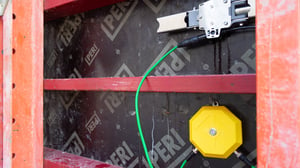
The fundamental limitation of any pre-pour calculation is that it is based on assumptions. Real-time pressure monitoring replaces those assumptions with measurements. A sensor mounted flush with the formwork surface measures the actual hydrostatic load at that point, continuously, from the moment concrete contacts the form surface to the point at which pressure has fully decayed after the pour is complete.
The engineering value operates at two levels. In the immediate term, it provides the site team with the information they need to make rational decisions about pour rate in real time. If pressure is tracking below the theoretical curve, pour rate can be safely increased. If it is tracking above, pour rate must be reduced before the load reaches a critical threshold.
Threshold management and automated alerting
Sensors are positioned vertically along the form — typically at the lower third and mid-height for walls up to 4 m, with additional sensors for taller elements. Threshold limits are configured in the monitoring system: a warning alert at 75–80% of the design capacity, and a critical alert at 85–90%. The critical threshold triggers a notification to the responsible engineer and the pour supervisor, with a clear requirement to halt or reduce the pour rate pending review.
Operational benefit demonstrated
Real-world deployments of continuous formwork pressure monitoring have demonstrated pour time reductions of up to 30% on comparable elements, achieved by safely increasing pour rates when measured pressures confirm sufficient headroom below the design threshold. The reduction in formwork occupation time directly compresses the construction schedule and reduces plant costs — without compromising safety.
Documentation and the regulatory dimension
Major structural concrete projects increasingly include specifications that require documented evidence of controlled concreting operations. A continuous pressure log from every pour satisfies this requirement in a way that a pour card signed by the site foreman cannot. It provides a timestamped, objective record of the load applied to the formwork, the pour rate maintained, and any corrective actions taken.
Summary: the case for measured data over calculated assumptions
The design standards give us a rational basis for dimensioning formwork. They do not give us certainty about what will happen on site on a specific pour day with a specific mix from a specific plant. That certainty comes from measurement.
Real-time formwork pressure monitoring does not replace the engineer. It extends the engineer's reach into the pour itself, providing the data that translates planning assumptions into controlled execution. The result is safer pours, faster cycles where the concrete allows it, and a documented record that the operation was conducted within design limits from first lift to last.
The sensor is not a substitute for engineering competence. It is what engineering competence looks like when it has the right data to work with.
References & Standards
- Ding, Z. et al. (2016). An experimental study on the lateral pressure of fresh concrete in formwork. Construction and Building Materials, 111, pp. 450–460.
- Proske, T., Graubner, C.-A. et al. (2014). Form pressure generated by fresh concrete: a review about practice in formwork design. RILEM TC 233-FPC.
- DIN 18218:2010-01. Pressure of fresh concrete on vertical formwork. Deutsches Institut für Normung.
- ACI 347R-14. Guide to Formwork for Concrete. American Concrete Institute.
- EN 206:2013+A2:2021. Concrete — Specification, performance, production and conformity. CEN.
- Hurd, M.K. (2007). Lateral pressures for formwork design. Concrete International, June 2007, pp. 32–38.
See formwork pressure monitoring in action
We will walk you through a live demo of the PREMO sensor system and the monitoring dashboard in 20 minutes — no obligation.