


Skip to content
concrete-temp-monitoring-device-on-site

Concrete Doesn't Own a Calendar

The Maturity Method, Explained Simply

 It's 7 a.m. on a construction site. The slab was poured two days ago, the next crew is waiting, and everyone is asking the same question: Is the concrete strong enough to remove the formwork? For a long time, the honest answer was "probably." Decisions were based on rules of thumb, experience and a few test specimens that were crushed in a lab somewhere else. This article explains a method that makes the answer much more reliable. It's called the maturity method.

We'll look at what actually happens inside concrete as it hardens, why the calendar is a poor guide, how the maturity method works step by step, where it's standardized, where it pays off and where its limits are.

What happens inside concrete

Fresh concrete is a mix of cement, water, sand and gravel. The sand and gravel are just filler. The real work is done by the cement. When cement meets water, a chemical reaction called hydration begins. Tiny crystals grow out of the cement particles, interlock with each other and glue the whole mix together. The more crystals have formed, the stronger the concrete is. This reaction doesn't happen all at once. It starts slowly, then speeds up during the first hours and days, and then gradually slows down again. Most of the strength that matters for construction decisions, such as when formwork can be removed, develops in the first few days. Hydration also produces heat. That's why freshly poured concrete often gets noticeably warmer than the air around it, especially in thick walls, foundations or large slabs. This detail will become important later. 

Why "days" is the wrong unit

Like most chemical reactions, hydration depends heavily on temperature. Warmth speeds it up, cold slows it down, and when it gets cold enough, the reaction almost stops. It's similar to dough rising: in a warm kitchen it's ready in an hour, in a cold cellar it takes much longer, even though it's the same dough. Because of this, "the concrete is three days old" tells you very little on its own. Three days in a mild summer and three days in a freezing November produce very different concrete. Time alone doesn't tell you how strong it is. Time combined with temperature does. On many sites, this is still handled with fixed waiting times, for example "strip the slab after X days," sometimes with an extra allowance in winter. These rules are simple, but they have a built-in problem. To be safe in bad conditions, they have to be conservative, which means crews often wait longer than necessary. And if conditions are worse than the rule assumes, 2 they're not conservative enough. 

The idea in one sentence

The maturity method keeps track of how much warmth the concrete has received over time and uses that total to estimate how strong it is. A helpful picture is a savings account. Every hour, the concrete "deposits" some warmth into its account. A warm hour is a big deposit, a cold hour is a small one, and a freezing hour adds almost nothing. The running balance is called the maturity. The key rule behind the method is simple: the same concrete mix with the same balance has roughly the same strength, no matter whether it got there quickly in the heat or slowly in the cold. So instead of asking "How old is the concrete?", you ask "How much warmth has it collected?" That question has a measurable answer, because temperature is easy to measure, continuously and without damaging anything. 

Why test samples can be misleading

Traditionally, strength is checked with small test specimens (cubes or cylinders). They are made from the same concrete, stored nearby or in a lab, and crushed in a press. That sounds reliable, but there's a catch: a small sample doesn't experience the same temperatures as the real structure. Think of a cup of tea next to a large pot of soup. Both start equally hot, but the cup cools down much faster. Concrete behaves the same way. Remember the heat that hydration produces: a thick wall or slab holds on to that heat much better than a small test cube, which loses it almost immediately.

As a result:

  •  In normal or warm conditions, the real element is often stronger than the test sample suggests. Crews wait longer than they need to.

  • In cold weather, it can be the other way around. A sample stored in a heated lab looks fine, while the real slab on an exposed deck is still weaker than expected. That's the risky case.

There's also a practical problem. Specimens have to be made, stored, transported and tested, and the result arrives hours or days later. By then, the decision on site has often already been made. And a single specimen represents one sample of concrete, not the edge of a slab that was exposed to wind all night. The maturity method avoids these problems because it measures the temperature where it matters, inside the actual structure, and it delivers the result continuously instead of on the next lab day.  

How it works in practice

Step 1: Teach the system your mix.

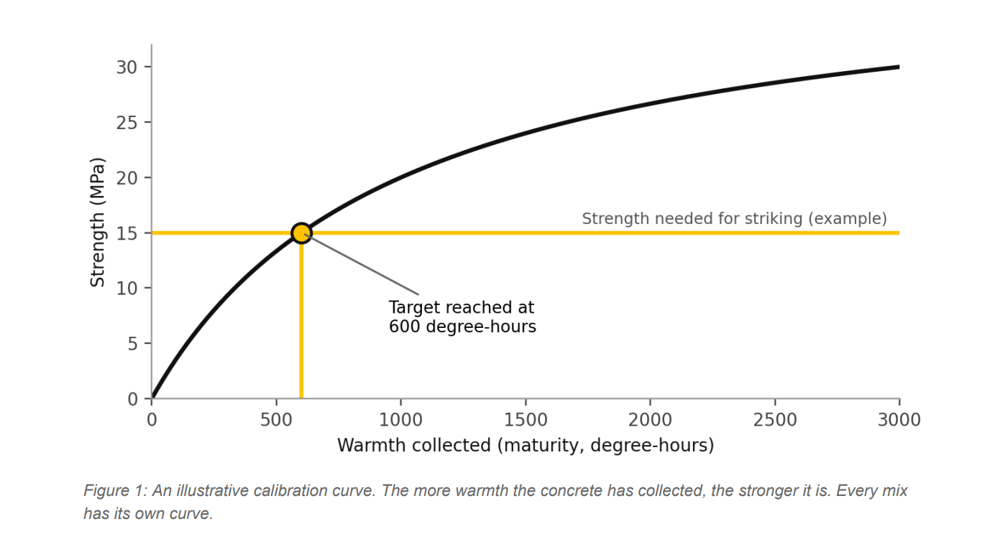
Every concrete mix gains strength at its own pace, depending on the type of cement, the amount of water, additives and other ingredients. That's why the method starts with a one-time calibration. In a lab, specimens of the exact mix are made. Some are fitted with temperature sensors, the others are tested for strength at several ages. For each test, the strength is paired with the warmth collected up to that point. Together, these pairs form a curve that connects "warmth collected" to "strength reached" for this specific mix. You can think of it as the mix's personal translation table.


Step 2: Measure on site.

Before the pour, small temperature sensors are fixed to the reinforcement at the relevant locations. From the moment the concrete is placed, they record its temperature automatically, around the clock. Modern systems send the data wirelessly, so nobody has to walk to a sensor with a reader or cable.


Step 3: Read the strength.

Software adds up the warmth collected at each sensor and looks up the matching strength on the calibration curve. The site team sees an estimated in-place strength, in real time, for each position in the structure. If a target value is defined, for example the strength required for striking, the system can also show when it has been reached. 
A day-by-day look at a pour

 To make this more concrete, here's what the process can look like on a typical project:

  • Weeks before: the mix is calibrated in the lab, ideally with concrete from the same plant and the same recipe that will be delivered later.

  • The day before the pour: sensors are fixed to the reinforcement at the agreed positions, and each sensor is linked to the element and the calibrated mix in the software.

  • During the pour: the sensors start recording as soon as they're surrounded by concrete. The first hours show how warm the fresh concrete is and how quickly it starts to heat up.

  • The following days: the site manager checks the estimated strength on a laptop or phone instead of waiting for lab results. The coldest sensor is usually the one that decides.

  • Decision time: once all relevant sensors show the required strength, and any additional checks required for critical steps are done, the formwork can be removed or the next step can begin.

  • Afterwards: the temperature and strength history is stored and can be used as documentation for the project.   

Standardized in the US, recognized in Europe

In the United States, the maturity method has its own standard: ASTM C1074, "Standard Practice for Estimating Concrete Strength by the Maturity Method", first published in 1987. It covers the whole process step by step. It describes both calculation approaches (the simple sum and the equivalent age), explains how to calibrate a mix in the lab, and specifies which additional checks are required before critical steps such as stripping formwork or post-tensioning. That's why ASTM C1074 is the reference that many projects and sensor systems worldwide are built on.

In Europe, the execution standard EN 13670 explicitly allows in-place strength to be estimated from temperature measurements. However, it doesn't prescribe a detailed calibration procedure like ASTM C1074, so the practical details are left to national rules, guidelines and project specifications. 

Three ways to do the maths

You don't need to calculate anything yourself, but it helps to know that there are three common approaches. They all follow the same logic and only differ in how much weight they give to warm and cold hours.

The simple sum, known as the Nurse-Saul method, goes back to research from around 1950. It adds up "temperature above a lower limit × time." The lower limit, called the datum temperature, is the temperature below which the concrete is assumed to gain no strength at all. It's often set at around 0 °C, or determined in the lab for a specific mix. The result is given in degree-hours or degree-days. The method treats the effect of temperature as a straight line: twice as warm means twice as fast. That's easy to understand and works well within normal temperature ranges, roughly between 0 °C and 40 °C, which is why it's still widely used, especially in North America.

The equivalent age method (Freiesleben Hansen & Pedersen, 1977) is based on the Arrhenius equation from chemistry and describes the reaction more realistically. It uses a value called the activation energy, which describes how sensitive a particular cement is to temperature. Instead of degree-hours, the result is expressed as "this concrete is now as mature as if it had been stored for X days at 20 °C." This is more accurate when temperatures vary a lot or when concrete cures in extreme heat or cold. Both this method and Nurse-Saul are described in ASTM C1074.

The weighted maturity method was developed in the 1970s and refined by de Vree. It sits between the other two: instead of a general reaction model, it uses a cement-specific sensitivity value, the C-value, which is typically somewhere between 1.25 and 1.75. The C-value can often be obtained directly from the cement producer, which makes the method practical in day-to-day use. It's standardized in the Netherlands as NEN 5970 and is widely used in Europe, particularly in systems that work with pre-calibrated cement data.

Which method is used matters less than using it consistently. The calibration curve, the maturity calculation and the target values on site all have to be based on the same method

Vemaventuri's systems support both methods described in ASTM C1074, Nurse-Saul and Arrhenius (equivalent age), so you can work with whichever one your project or specification requires.

A simple example

The numbers in this example are illustrative and simplified.


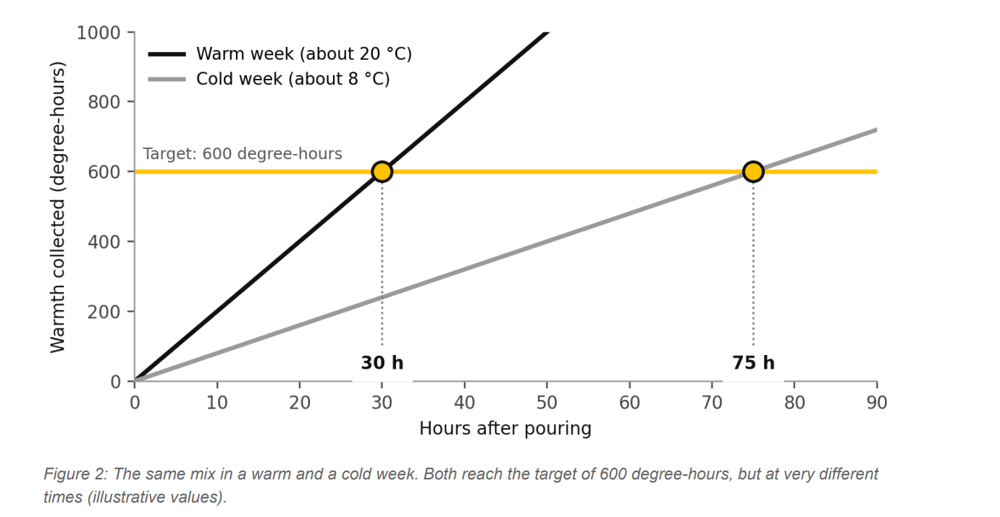
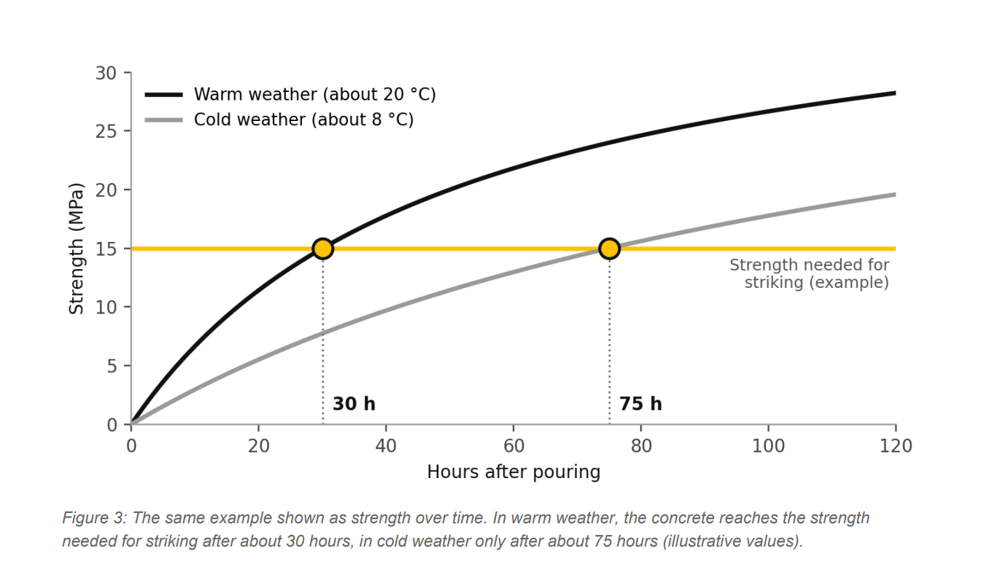
Let's say the calibration shows that a particular mix reaches the strength required for striking once it has collected 600 degree-hours, meaning, for example, 60 hours at 10 °C above the lower limit.

  • A warm week: the concrete stays at about 20 °C. It reaches 600 degree-hours after roughly 30 hours.

  • A cold week: the concrete only reaches about 8 °C. It needs roughly 75 hours for the same result. 
Maturity 2


Same mix, same target strength, but a difference of almost two days. With a fixed rule like "strip after 48 hours," you'd wait a day longer than necessary in the warm week and strip too early in the cold one. With maturity monitoring, the sensor shows when the target has been reached. 
Maturity 3


In reality, temperatures change constantly: the concrete warms up from hydration, cools down at night and warms again during the day. That's exactly why the sensors record them continuously, typically every few minutes, rather than relying on an average. 

Where to place the sensors

The maturity method measures the temperature at the point where the sensor sits. So the most important question is: which points are relevant for the decision? A few principles help:

  • The coldest spots: edges, corners and thin sections lose heat faster than the middle of a slab. Top surfaces exposed to wind and cold nights are also critical. If the coldest point has reached the target strength, the rest of the element usually has as well.

  • The structurally critical spots: areas that carry the most load when the formwork is removed, such as around supports, or anchor zones in post-tensioned elements. The structural engineer knows where these are.

  • The last section poured: on long pours, concrete placed at the end of the day is several hours younger than the concrete from the morning. It's usually better to use a few well-placed sensors than many randomly placed ones. The engineer responsible for the project should agree on the positions in advance. 

Where it really pays off

  • Formwork and climbing cycles: Knowing the right moment to strip, move or climb formwork can shorten every cycle. On multi-storey projects, this adds up over the whole schedule, and less formwork has to be kept on site at the same time.

  • Post-tensioning and loading: Tendons may only be stressed once the concrete has reached a defined strength. Measured data replaces waiting for lab results, and it shows the strength at the anchor zones, where it really matters.

  • Winter concreting: In cold weather, you can see whether the concrete is really gaining strength and when protective measures such as heating or insulation can be removed. This avoids both risks: removing protection too early and paying for heating longer than needed.

  • Summer concreting: In hot weather, the same temperature data shows whether the concrete is getting too warm, which can cause cracks or reduce long-term quality.

  • Lower-carbon concrete: Many climate-friendlier cements with less clinker gain strength more slowly at the start. That makes it harder to plan with fixed rules of thumb, and it's exactly where the maturity method helps. When you can see the actual strength development, it's easier to use these mixes with confidence instead of avoiding them because of schedule risk.

  • Documentation: The recorded data shows what really happened in each element. That's useful for quality records, handovers and any questions that come up later. 

What the method can't do

The maturity method is powerful, but it isn't magic. It's worth knowing its limits.
  • It's only as good as its calibration. A thermometer can't tell whether the delivered concrete matches the calibrated recipe. If the mix changes or extra water is added on site, the curve no longer fits. For critical steps, standards therefore require additional checks to confirm that the right concrete was delivered. It also makes sense to review the calibration whenever the supplier, cement or recipe changes.

  • It assumes proper curing. Hydration needs water. Concrete that dries out too early doesn't gain strength as expected, no matter how warm it is.
  • It's best for early-age decisions. Concrete that is very warm in its first days tends to gain strength quickly at first but can end up slightly weaker later on than concrete that hardened more slowly. That's why the method is mainly used for decisions in the first days and weeks, not for predicting final strength.
  • It doesn't replace conformity testing. The standard tests used to prove that the delivered concrete meets its specified strength class, usually at 28 days, are still required. The maturity method answers a different question: how strong is the concrete in this element right now?

  • Sensor placement matters. A sensor only knows the temperature at its own position. If it's installed where it's convenient rather than where it's critical, the result can be misleading.

So the method doesn't replace every lab test. It replaces guesswork on the question that matters most on site: Is it ready now?

Sensor Solution

Maturity monitoring with Vemaventuri

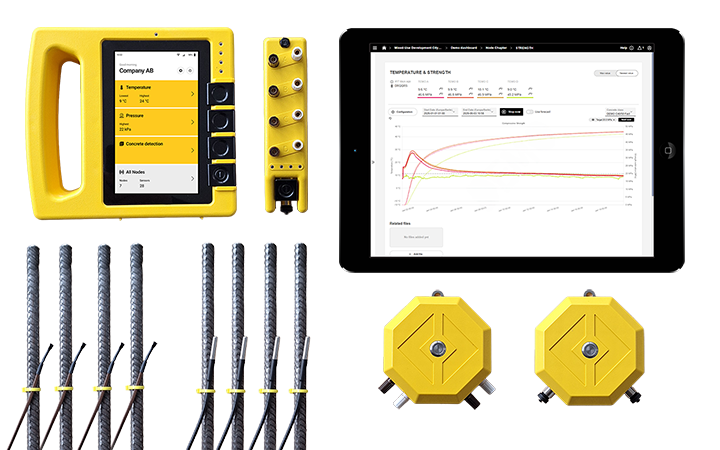
Vemaventuri's sensor systems TEMO, TEMO Link and LINK measure concrete temperature directly in the structure and calculate maturity and estimated strength automatically. The data is available around the clock in the web application, so site managers, engineers and planners all work from the same numbers and have the documentation ready at the end.
 

References & Standards

  • ASTM C1074-19e1. Standard Practice for Estimating Concrete Strength by the Maturity Method. ASTM International.
  • EN 13670:2009. Execution of concrete structures.
  • EN 206:2013+A2:2021. Concrete: specification, performance, production and conformity.
  • Nurse, R.W. (1949). Steam curing of concrete. Magazine of Concrete Research 1.
  • Saul, A.G.A. (1951). Principles underlying the steam curing of concrete at atmospheric pressure. Magazine of Concrete Research 2.
  • Freiesleben Hansen, P. & Pedersen, E.J. (1977). Maturity computer for controlled curing and hardening of concrete. Nordisk Betong 1.
  • Carino, N.J. & Lew, H.S. (2001). The Maturity Method: From Theory to Application. Proceedings of the 2001 Structures Congress & Exposition, ASCE.

Curious about concrete performnce monitoring?

We will present the Vemaventuri solution to you in a 20-minute online demo without any obligation.