

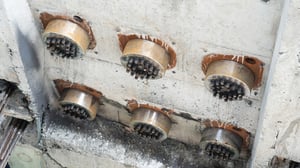
Why Concrete Quality Matters in Post‑Tensioned Structures
Post‑tensioned concrete structures are designed for efficiency, durability, and long service life. Their performance, however, depends not only on correct stressing and grouting procedures, but just as critically on the quality and condition of the surrounding concrete in which tendons, ducts, anchor zones, and deviators are embedded.
In practice, many of the most consequential risks in post‑tensioned structures originate before post‑tensioning even begins. Voids, honeycombing, insufficient compaction, or poorly consolidated concrete around ducts and anchorages may remain hidden once formwork is stripped, yet they directly affect durability, load transfer, and long‑term performance. Traditional quality control methods rely largely on visual inspection and procedural compliance, even though these methods cannot reliably verify what is happening inside the concrete during placement. The few quantitative options available—such as ultrasound or X‑ray testing—are typically expensive, time‑consuming, limited in coverage, and often impractical for large infrastructure pours, making them unsuitable as a routine quality assurance method.
This is particularly relevant in post‑tensioned applications with complex geometry, congested reinforcement, thick sections, or high placement rates—conditions commonly found in bridges, segmental construction, anchor blocks, and infrastructure projects. In these environments, even well‑executed construction processes can result in localized defects that are difficult or impossible to detect after the pour.
Beyond placement quality, the timing of post‑tensioning itself represents another critical interface between concrete behavior and structural performance. Tendons are stressed based on assumptions about concrete strength development, yet actual maturity and strength gain can vary significantly due to mix design, temperature, curing conditions, and placement execution. If concrete has not developed sufficient and uniform strength at the time of stressing, localized damage, cracking, or long‑term durability issues may occur—often without immediate visible signs.
Objective, real‑time insight during concrete placement and early curing helps address this uncertainty. Embedded monitoring solutions provide direct information on whether concrete has fully filled critical zones, whether compaction has been effective, and how the material develops in its early stages, rather than assuming performance based solely on time or external indicators. This enables project teams to better align construction decisions—such as formwork removal or post‑tensioning readiness—with the actual condition of the concrete.
From a post‑tensioning perspective, this matters because the concrete forms the structural environment in which tendons must perform for decades. Even the most rigorous post‑tensioning and grouting procedures cannot compensate for deficiencies in concrete quality or premature stressing. Ensuring proper placement, consolidation, and sufficient maturity therefore reduces risk at its source and creates a more robust foundation for all subsequent construction steps, including stressing and grouting.
In this context, digital concrete monitoring supports the same overarching objective pursued by modern post‑tensioning practice: minimizing hidden defects, improving documentation, and increasing confidence in long‑term structural performance. By moving quality control from assumption to verification, project teams gain a clearer understanding of actual construction outcomes—strengthening durability, reducing remedial work, and supporting the intended service life of post‑tensioned structures.
Vemaventuri provides an embedded monitoring solution that ensures concrete fill and compaction while also monitoring temperature and strength development in real time. The Vemaventuri PHONO and TEMO sensors are designed to deliver the critical data needed to drive quality, improve decision‑making, and enhance productivity. By offering continuous insight during placement and early curing, Vemaventuri’s technology can have a significant positive impact on the safe, efficient, and reliable delivery of post‑tensioned structures.
Curious about maturity monitoring and concrete detection and compaction monitoring?
We will present the Vemaventuri solution to you in a 20-minute online demo without any obligation.