


Skip to content

Download the printable Hot Weather Concreting Checklist for site use.

The Problem with Heat

Concreting under hot weather conditions is one of the most demanding challenges in day-to-day construction practice — not because the physics are unknown, but because the margin for error compresses dramatically and multiple interacting failure modes must be managed in parallel. According to ACI 305R-20, Guide to Hot Weather Concreting, any combination of elevated ambient temperature, low relative humidity, high wind speed, and solar radiation that accelerates moisture loss or cement hydration falls under the definition of hot weather — even a cloudy but windy day in spring can qualify.

What makes the condition particularly treacherous for structural work is that its effects begin before the first truck arrives on site. Mix temperatures can be elevated already at the batching plant, setting the clock ticking earlier than expected. From that point on, every delay in transport, every inefficiency during placement, every underestimation of formwork pressure — any one of these can cascade into permanent structural deficiency.

This article systematically walks through the key technical challenges and explains how continuous, data-driven sensor monitoring — across temperature/maturity, formwork pressure, compaction quality, and mix water-to-cement ratio — transforms these risks into manageable, documented parameters.

Accelerated Hydration and Loss of Workability

Cement hydration is a thermally activated process. The rate of hydration approximately doubles for every 10 K rise in concrete temperature — a relationship captured by the Arrhenius equation and the basis of the maturity concept under ASTM C1074. In practice, this means that a concrete delivered at 30 °C may have a working time 40–50 % shorter than the same mix at 20 °C, even with identical admixture dosing. Setting times compress, slump loss accelerates, and the risk of cold joints on large placements increases sharply.

The instinctive response on site — adding water — is the most damaging countermeasure possible. ACI 305.1-2014 explicitly prohibits exceeding the specified w/c ratio to compensate for slump loss. Every additional litre of water per cubic metre reduces 28-day compressive strength, increases permeability, and elevates the risk of both plastic and drying shrinkage cracking.

ACCELERATED SET

Compressed working window; higher risk of cold joints between successive layers in walls and columns.

 
SLUMP LOSS

Increased water demand on site leads to field water additions that directly compromise strength and durability.

 
PLASTIC SHRINKAGE CRACKING

Rapid surface evaporation exceeding bleed rate — the ACI threshold is 1.0 kg/m²/h — triggers early cracking before final set.

 
REDUCED LONG-TERM STRENGTH

Higher curing temperatures accelerate early strength gain but reduce ultimate strength ceiling by up to 10–15 % compared to concrete cured below 20 °C (Kim et al., 1998).


The standard countermeasures — precooling mix water, shading aggregates, using retarding or hydration-stabilising admixtures, scheduling night pours — are all well-established. What is still routinely missing is objective, real-time evidence that the concrete inside the structure is behaving as designed. This is precisely where embedded sensor technology closes the gap.

Vemaventuri Sensor Solution

Temperature & Maturity Monitoring

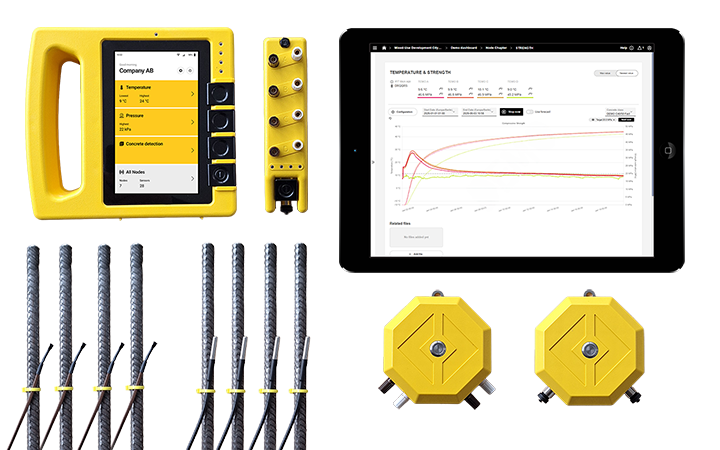
Embedded temperature sensors placed at critical cross-section depths provide a continuous thermal history from first pour through the end of the curing period. This time-temperature record is integrated using the Nurse-Saul or Arrhenius maturity function (ASTM C1074) to yield a real-time estimate of in-situ compressive strength — without waiting for cube or cylinder results.

In hot weather, this has direct operational implications: the construction team can identify when peak exothermic temperatures are reached, confirm that the concrete has attained the specified stripping strength before formwork is removed, and document compliance with temperature differential limits that guard against thermal cracking in mass-concrete elements. For columns and walls with short cycle times, sensor-derived maturity data can replace conservative time-based stripping schedules, safely accelerating the programme while maintaining full traceability.

Under EN 13670 and SIA 262 provisions for concrete work, continuous temperature records also satisfy the documentation requirements for curing surveillance in higher exposure classes. The sensor data provides an audit trail that cube tests alone cannot.

Learn more about temperature monitoring and the products
Learn more about maturity monitoring and the products
temp-strength-transparent


Formwork Pressure: A Non-Obvious Hot Weather Risk

The relationship between concrete temperature and formwork pressure is often misread. A common assumption holds that hotter concrete — with a shorter setting time — means lower lateral pressure on vertical formwork, and in purely hydrostatic terms this has some truth: the accelerated stiffening of the mix shortens the duration of full fluid pressure.

The risk arises precisely from this complexity. Research by Billberg (2003) and Proske & Khayat (2005) has shown that while higher temperature increases the rate of pressure drop after initial placement, the relationship is strongly non-linear and highly dependent on mix composition, admixture type, and placement rate. A mix with retarder dosed to recover workability at elevated temperatures may, under the ACI 347 and DIN 18218 design models, behave effectively as a full fluid-head mix for far longer than a standard mix at the same temperature.


Proske & Khayat (2005), Materials and Structures: Temperature variations in fresh concrete had limited effect on initial lateral pressure but significantly increased the rate of subsequent pressure drop — the implication being that peak pressure during placement is largely unaffected, while the decay rate is thermally accelerated.


For self-compacting concrete (SCC) — now widely used for complex reinforced geometries — this effect is amplified by the inherently lower yield stress of the mix, which generates near-hydrostatic pressures almost independent of placement rate. Standard ACI 347 and DIN 18218 equations were calibrated for normal-vibrated concrete and may significantly underestimate SCC pressures, particularly with retarder-dosed hot-weather mixes.

Formwork blowout remains one of the most severe and costly failure modes in construction — and one of the most preventable if pressure data is available in real time.

Vemaventuri Sensor Solution

Formwork Pressure Monitoring

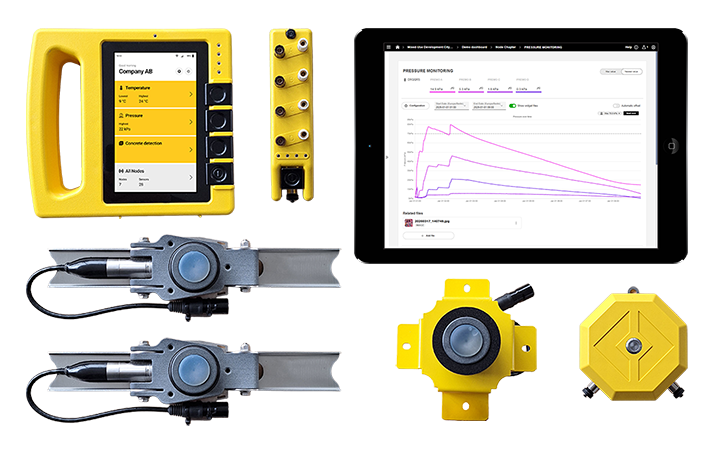
Pressure sensors mounted directly on the interior face of wall and column formwork deliver continuous lateral pressure readings throughout the pour. This allows the site team to observe actual pressure development in real time and compare it against the design envelope — not post-hoc, but while the concrete is still being placed and before an unsafe condition can propagate.

In hot weather conditions where retarding admixtures have been used to extend workability, sensor-based monitoring is the only reliable way to verify that the actual pressure behaviour matches the design assumption. Any deviation from expected decay rates triggers an immediate alert, allowing placement to be slowed or paused before a critical threshold is reached.

The recorded pressure profiles also serve as objective evidence for post-pour structural review, supporting the validation of formwork designs for future similar pours and underpinning formwork system approval under EN 13377 and DIN 18218.

Learn more about the application and products
pressure-transparent


Compaction Quality and Void Detection

Adequate compaction is always critical to concrete quality, but in hot weather concreting the risks compound. A rapidly stiffening mix is less forgiving of delayed or inadequate vibration. The effective radius of action of an immersion vibrator decreases as concrete stiffness increases, meaning the same vibration protocol that delivers full compaction at 20 °C may leave pockets of trapped air at 32 °C — with identical visible result at the formwork face.

Published data confirms that each additional 1 % of entrapped air by volume reduces compressive strength by approximately 5 % (ACI 309R). For lightly reinforced members this is a manageable defect; for post-tensioned structures, thin-section precast elements, or infrastructure components with tight durability requirements, it is not.

The particular challenge is invisibility. Voids beneath or around reinforcement, in zones remote from vibrator insertion points, or behind pre-installed components are undetectable until the formwork is struck — at which point the contractor faces a costly and time-sensitive repair or, in the worst case, a structural assessment. Traditional quality assurance — visual inspection at the formwork face and concurrent cube testing — gives no information about the interior of the pour.

Vemaventuri Sensor Solution

w/c-Ratio Determination at the Point of Pour

The vemaventuri sensor system enables rapid, non-destructive determination of the actual water-to-cement ratio of fresh concrete immediately before placement — at the discharge point, rather than at the batching plant. This provides a direct, objective check on the most critical mix parameter before a single cubic metre enters the structure.

In hot weather operations, where slump loss during transit creates persistent pressure to add water, the ability to document the delivered w/c ratio at each truck discharge shifts the quality conversation from verbal instruction to measured fact. Any truckload that arrives with a w/c ratio exceeding the specification limit can be identified, rejected or corrected before placement — protecting both the structure and the contractor from latent defects that may only manifest months or years later as increased permeability, carbonation depth, or premature reinforcement corrosion.

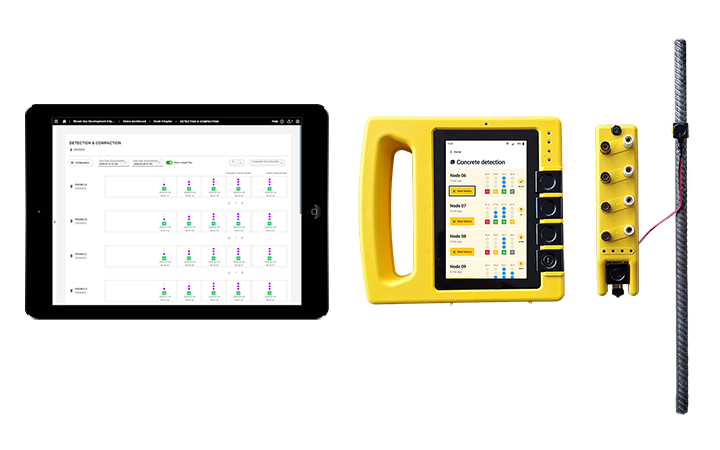
In hot weather conditions, where the reduced working time compresses the compaction window, real-time feedback on fill level and vibration coverage allows the crew to prioritise their effort where it is most needed, rather than relying on a fixed pattern that may have been calibrated for slower-setting conditions.
Learn more about the product

detection-compaction-transparent


Water-to-Cement Ratio Control at the Point of Delivery

The water-to-cement (w/c) ratio is the single most important parameter governing both the strength and durability of hardened concrete. It is also the parameter most vulnerable to hot weather field conditions — precisely because the primary symptom of inadequate workability is slump loss, and the simplest on-site response is water addition.

The chain of custody problem is well known in concrete construction. Mix design is verified at the batching plant. But concrete delivered in summer conditions — after 20–40 minutes of transit in a drum turning at agitation speed — may arrive several slump classes below specification. The driver reports to the pump operator; the pump operator flags the foreman; and the path of least resistance is the water addition hose.

ACI 305.1-2014, Section 5.7, and EN 206 both prohibit water addition beyond the specified mix proportions. In practice, prohibition without measurement is unenforceable. Without an objective, rapid means of determining the actual w/c ratio of the concrete as delivered, compliance relies entirely on site discipline and verbal instruction — a fragile control mechanism on a busy construction site at 35 °C.

Vemaventuri Sensor Solution

w/c-Ratio Determination at the Point of Pour

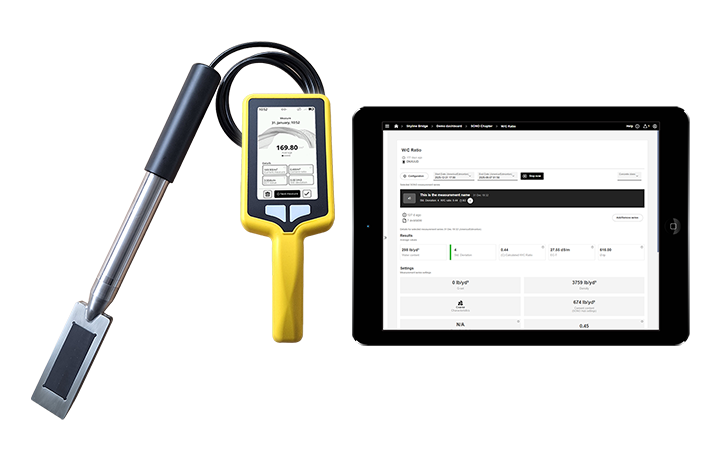
The vemaventuri sensor system enables rapid, non-destructive determination of the actual water-to-cement ratio of fresh concrete immediately before placement — at the discharge point, rather than at the batching plant. This provides a direct, objective check on the most critical mix parameter before a single cubic metre enters the structure.

In hot weather operations, where slump loss during transit creates persistent pressure to add water, the ability to document the delivered w/c ratio at each truck discharge shifts the quality conversation from verbal instruction to measured fact. Any truckload that arrives with a w/c ratio exceeding the specification limit can be identified, rejected or corrected before placement — protecting both the structure and the contractor from latent defects that may only manifest months or years later as increased permeability, carbonation depth, or premature reinforcement corrosion.

The combination of pre-pour w/c monitoring with in-situ maturity tracking provides a complete picture: the concrete that went in was within specification, and the concrete as it cured developed strength along the expected trajectory. This is the level of documentation that demanding clients, structural engineers of record, and increasingly, insurers are beginning to require.
Learn more about the product

w-c-value-transparent


The Integrated Monitoring Picture

Taken individually, each sensor capability addresses a specific and significant risk. Together, they constitute a continuous, multi-parameter quality record of the entire concreting operation — from delivery through hardening. The table below summarises how the four measurement domains map to the principal hot weather failure mechanisms.

Hot weather risk Consequence if unmanaged Vemaventuri sensor response
Accelerated hydration / short working time Cold joints, incomplete placement, early cracking Temperature & maturity monitoring — real-time strength tracking, programme optimisation
On-site water addition exceeding w/c specification Reduced strength, increased permeability, durability failure w/c-ratio determination at truck discharge before placement
Formwork pressure with retarder-dosed mix Formwork deflection, blowout, structural incident Continuous lateral pressure sensing with real-time alerting
Rapid stiffening compressing compaction window Trapped air, reduced strength, void defects around reinforcement Ultrasonic fill detection with vibration coverage logging
Thermal gradient in mass concrete elements Thermal cracking due to differential expansion between core and surface Multi-depth temperature arrays with gradient monitoring and alerting

The fundamental shift enabled by this monitoring architecture is from reactive to proactive quality management. Traditional methods — cube testing, slump measurement, visual inspection — are diagnostic tools that reveal problems after the fact, often after the defective concrete has been encased or loaded. Sensor-based monitoring intervenes during the process, when correction is still possible and before defects are locked into the structure.

Key takeaways for the construction engineer

  • Hot weather concreting compresses working time and amplifies every process inefficiency simultaneously — multiple failure modes must be managed in parallel.
  • The w/c ratio is the most critical parameter and the most vulnerable to field deviation; it must be verified at the point of delivery, not assumed from the plant record.
  • Formwork pressure cannot be reliably predicted from temperature alone when retarding admixtures are used — measurement is the only safe approach.
  • Compaction adequacy cannot be confirmed visually; ultrasonic sensing is the only practical method for verifying fill around dense reinforcement and pre-installed components.
  • Maturity monitoring replaces conservative time-based stripping schedules with documented in-situ strength data, safely accelerating programme without compromising quality.
  • The combination of all four sensor domains provides a complete, traceable quality record — meeting the growing documentation demands of clients, structural engineers, and insurers

References & Standards

  1. ACI Committee 305 (2020). ACI 305R-20: Guide to Hot Weather Concreting. American Concrete Institute, Farmington Hills.
  2. ACI Committee 305 (2014). ACI 305.1-14: Specification for Hot Weather Concreting. American Concrete Institute.
  3. ACI Committee 347 (2014). ACI 347R-14: Guide to Formwork for Concrete. American Concrete Institute.
  4. ASTM C1074 (2019). Standard Practice for Estimating Concrete Strength by the Maturity Method. ASTM International.
  5. DIN 18218:2010. Frischbetondruck auf lotrechte Schalungen. Deutsches Institut für Normung.
  6. EN 13670:2009. Execution of concrete structures. CEN, Brussels.
  7. EN 206:2013+A2:2021. Concrete — Specification, performance, production and conformity. CEN, Brussels.
  8. Proske, T. & Khayat, K.H. (2005). Effect of casting rate and concrete temperature on formwork lateral pressure of SCC. Materials and Structures, 38, 1–8.
  9. Saul, A.G.A. (1951). Principles underlying the steam curing of concrete at atmospheric pressure. Magazine of Concrete Research, 2(6), 127–140.
  10. Carino, N.J. & Lew, H.S. (2001). The maturity method: from theory to application. Proceedings, Structures 2001 Congress, ASCE.
  11. ACI Committee 309 (2005). ACI 309R-05: Guide for Consolidation of Concrete. American Concrete Institute.

Standards Referenced

ACI 305R-20

ACI 305.1-14

ACI 347R-14

ASTM C1074

DIN 18218

EN 13670

EN 206 

Curious about concrete performnce monitoring?

We will present the Vemaventuri solution to you in a 20-minute online demo without any obligation.