Description
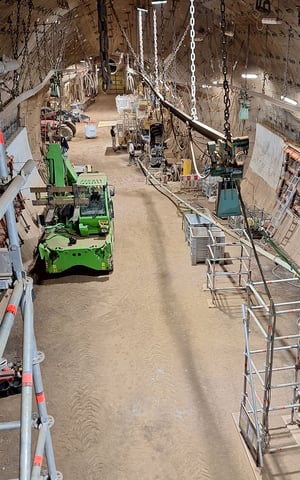
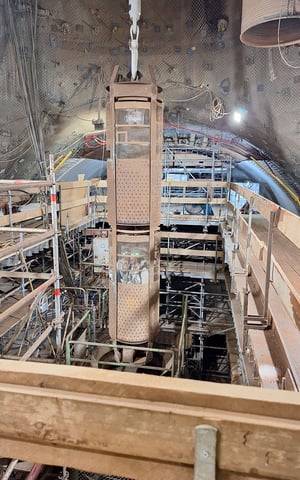
The "Schacht Konrad 2" project is part of the BGE's large-scale undertaking to convert a decommissioned iron ore mine in Salzgitter into Germany's first legally approved final repository for low- and intermediate-level radioactive waste. The transfer point for radioactive waste (called the "Füllort", or shaft station) lies roughly 850 meters underground and forms the central transport hub: this is where the waste containers arrive and are then moved onward through the underground tunnel network to the designated emplacement chambers. To make this possible, the old mining facility is being fundamentally redesigned, with massive above-ground handling facilities, a new hoisting tower, and a reinforced shaft lining that must meet strict nuclear safety requirements. Underground, one thing matters above all: material stability. Reinforced concrete seals the cavern lining, forms the transport foundations, and ultimately fills every remaining void so that the radioactive waste packages are permanently enclosed. The work in the shaft is carried out by ARGE Schacht Konrad 2 (ASK 2), a consortium of Redpath Deilmann GmbH and Thyssen Schachtbau GmbH, on behalf of the BGE (Bundesgesellschaft für Endlagerung mbH, the Federal Company for Radioactive Waste Disposal).
Challenges
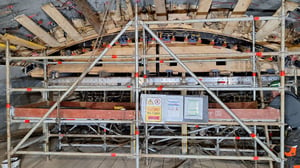
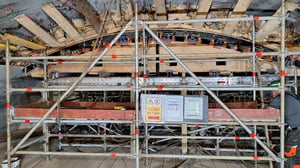
Casting against the existing shaft structure is the central formwork challenge here. Large sections of the new linings and foundations go in as single-sided formwork against decades-old rock support, where both the formwork and the existing structure have to withstand the fresh concrete pressure. Engineering teams know how to calculate single-sided formwork loads, but they do so with safety margins built in for the unknowns, since actual pressure development against an existing structure isn't something a calculation alone can confirm on site.
- Single-sided formwork against existing rock support: standard calculation covers the load case, but not the actual pressure behavior on site, and getting the pour rate wrong is a direct risk to the formwork system and to a structure that serves as the primary transport link into the repository's tunnel network
- Quality risk (voids) at the interfaces: full concrete coverage around reinforcement against existing rock support and lining, and any void in these critical sections is a defect that can't be tolerated in a structure of this consequence, with no way to check again once backfilled
- Elevated temperature at depth: simply part of the working environment, alongside confined access and long transport routes typical of underground construction
- No mobile signal underground: any monitoring approach that depends on a constant cloud connection to show live data doesn't work down here
In short: engineers here needed two things standard calculation and visual inspection couldn't fully deliver — measured formwork pressure for a single-sided pour against existing structure, and verified concrete presence for a high-quality result at the critical interfaces.
Solution and results
Site management equipped the critical formwork sections with PREMO and PHONO to replace calculated safety margins and visual judgment with measured, verified data at the pour.
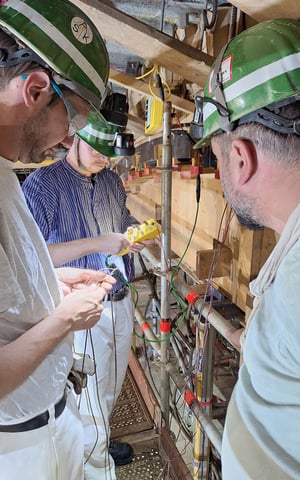
- PREMO Concrete Pressure Monitoring measured actual concrete pressure against the formwork in real time, giving engineers the true pressure curve as it developed against the existing structure and a measured basis to adjust concreting speed. Component temperature was logged in parallel as a reference and documentation parameter.
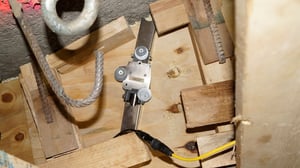
- PHONO Concrete Detection confirmed that concrete was actually present where it needed to be, particularly at the interfaces against existing rock support and lining where single-sided formwork makes visual confirmation impossible, letting engineers verify coverage around reinforcement and built-in parts directly from the sensor data.
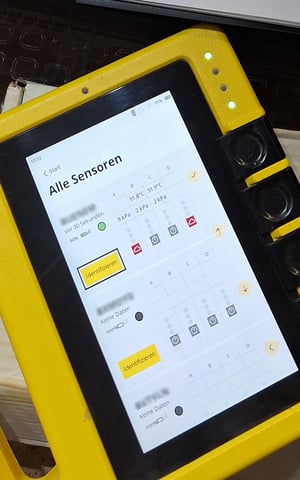
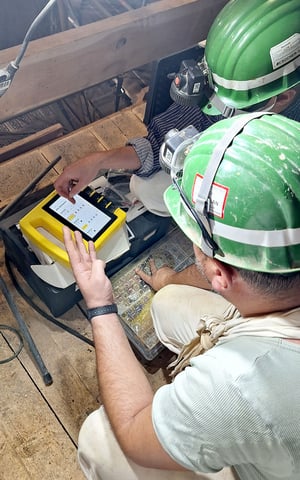
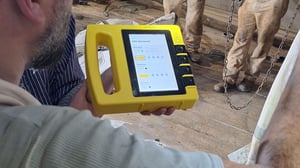
- Hub and Node Solution made this possible without mobile signal underground: sensor data is collected locally by the Node and displayed live on the Hub, a tablet engineers read directly at the pour. The Hub only needs to reach the surface periodically to sync stored data to the cloud and web app for documentation, while the live analysis itself runs entirely offline, right where the decision is made.
Throughout the pour, the team kept coming back to the Hub, not because they doubted their own judgment, but to check it against what the data actually showed, and to get back the kind of certainty that matters this far underground.
Together, PREMO and PHONO gave site engineers a live, measured picture of formwork pressure and concrete presence at the pour, replacing safety-margin assumptions and visual judgment with a data record specific to each pour against the existing structure, at a portal that serves as the primary link between surface and the repository's tunnel network.