

Skip to content

In Brief

Self-compacting concrete (SCC) is designed to flow into complex or heavily reinforced formwork without conventional vibration. But once placed, it does not remain in the same fresh state: it builds internal structure, hardens and interacts differently with each new layer placed above it.

In other words, formwork pressure, rate of rise, temperature, interruptions, filling, and interlayer bond are all linked. They are different parts of the same time-dependent process, even though site teams often talk about them as separate issues.

The central question is not simply whether SCC should be poured fast or slow, but whether the conditions assumed during planning still match the concrete and the pour on site. 

Why SCC changes after placement

Self-compacting concrete flows into the formwork under its own weight, filling the form and passing through dense reinforcement without vibration. That makes it valuable in heavily reinforced elements, complex geometry and anywhere a vibrator cannot realistically reach, and it removes a source of variability that is difficult to control.

The same property is the reason SCC deserves particular attention during placement. Fresh SCC can behave much more like a fluid than conventionally vibrated concrete, so formwork pressure is often designed conservatively, including full hydrostatic pressure where required.

Once SCC comes to rest, however, its behaviour changes, and two processes run in parallel:

  • It stiffens without hardening. Mixing, pumping and flowing keep the concrete moving. When that movement stops, it rebuilds internal structure and softens again when disturbed. This is usually described through thixotropy.

  • It hardens. At the same time, cement hydration is under way, and that stiffening cannot be reversed.

Together, these are why the pressure transmitted to the formwork can begin to fall after placement rather than remaining at its initial value. Put differently: the pressure acting on the formwork at any moment depends heavily on how long the concrete underneath has been sitting undisturbed, which is as much a question of site sequencing as it is of the mix.

This is also why SCC formwork pressure is not governed by one number alone. Mix characteristics, temperature, rate of placement, geometry and interruptions all matter. Because that behaviour varies from mix to mix, designing for full hydrostatic pressure remains the safe route while the actual behaviour is unknown — though it comes at a price, since such a form is heavier, needs more ties and takes longer to assemble.

Before the pour: consistency still matters

All of that describes concrete that is behaving as intended. It assumes the material arriving at the formwork is the material that was specified and with SCC that is a narrower assumption than it sounds.

High flowability alone does not make good SCC. The concrete must flow and pass through reinforcement while remaining stable enough to resist segregation, and that balance is narrower than with conventional concrete. Small changes in batching, aggregate moisture, admixture dosage or water content can push it out of specification in either direction: too stiff to fill properly, or too fluid to stay stable.

Established SCC tests therefore remain essential. Monitoring does not replace them.

What is being checked Test Standard
How well the concrete flows Slump-flow, t500 EN 12350-8
How viscous it is while flowing V-funnel EN 12350-9
Whether it passes reinforcement L-box / J-ring EN 12350-10 / -12
Whether it segregates Sieve segregation EN 12350-11

Behind all of them sits water content as a governing variable. The water/cement ratio influences strength and durability, and it is also among the things most likely to shift between the batching plant and the point of placement.

Vemaventuri Sensor Solution

Water Content & W/C Ratio Determination of Fresh Concrete

SONO Hub determines the water content of fresh concrete on site and, where the required mix information is available, calculates the water/cement ratio. That allows the delivered material to be checked before it becomes part of the structure.

It does not replace established SCC acceptance testing under EN 12350. It adds a measured value at delivery, turning a judgement into a documented figure.

 

With the delivered mix confirmed, the next decision is how quickly it goes into the form.

Rate of rise: an operating parameter, not a law

Rate of rise describes how quickly the concrete level climbs inside the formwork, usually in metres per hour. Its link to pressure is straightforward:

  • Place faster: fresh concrete arrives before the SCC below has had much time to build structure, so pressure can remain high.

  • Place slower: the SCC below has more time to stiffen, so pressure may begin to decay.

The framing matters. The formwork has a pressure capacity, and rate of rise is one of the operating parameters used to stay within it. It is not the other way round, and it is not a fixed property of the concrete. Which rate works depends on the constituent materials, the mix, the concrete temperature, the reinforcement density and the geometry — so a calculated rate belongs to one particular mix and one particular pour, not to "SCC" as a material.

In practice, the rate is agreed before the pour between the concrete supplier, the formwork designer and the site team, each bringing an assumption about the mix, the temperature and pour height, or the delivery intervals. The pour then runs on the combination of all three.

Vemaventuri Sensor Solution

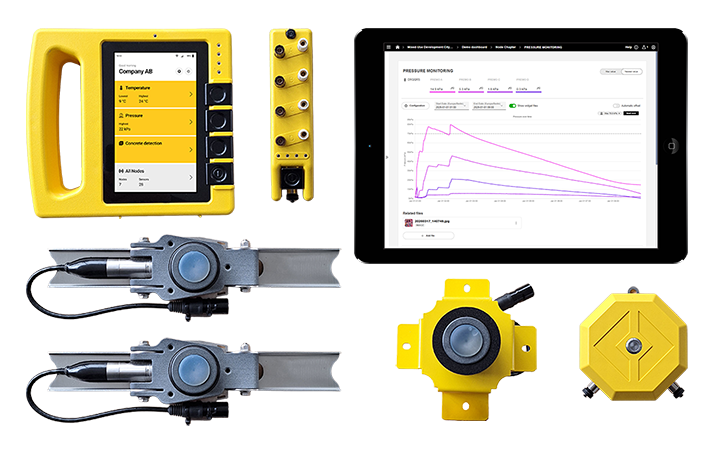
Concrete Pressure Monitoring

PREMO measures the fresh-concrete pressure acting on the formwork during placement, so the site team can follow the real pressure curve instead of relying only on a predicted one. If the curve deviates from what was expected, that becomes visible while there is still time to slow down or pause.

Afterwards, the recorded profiles serve as documentation and can help validate formwork designs for comparable pours. Where pressure, temperature and strength development need to be seen together, ISC Linkcombines them in one system and has built-in cellular connectivity, so it doesn't need a separate Hub to get data off site.
Temperature changes the calculation

Concrete temperature is not the same as air temperature, and the concrete arriving at the formwork may not be at the temperature the calculation was built on.

Temperature matters because it influences how quickly the concrete develops. Broadly, colder conditions can slow hardening and pressure decay, while warmer conditions can accelerate them. But that does not translate into a rule of thumb: research indicates temperature mainly affects how quickly pressure falls again and has far less influence on the peak value, and where retarders are used to hold workability in the heat, a warm mix can stay fluid longer than a cold one. SCC is mix-dependent, so "warmer means less pressure" is not a safe assumption on its own.

 Rate of rise tells us how quickly fresh SCC is being added. Temperature helps determine how quickly the SCC already placed is changing. Both run at the same time. 

Vemaventuri Sensor Solution

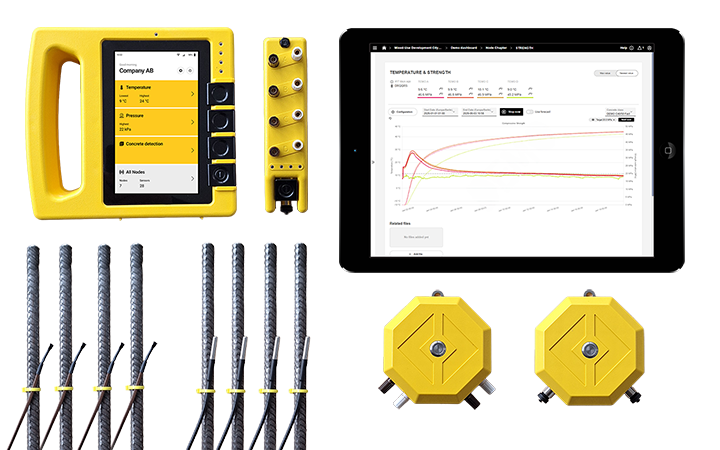
Concrete Temperature and Maturity Monitoring

TEMO and TEMO Link monitor concrete temperature continuously inside the element, rather than inferring it from the weather or a single reading. Where the concrete has been appropriately calibrated, the same temperature history can also be used for maturity-based strength assessment, which supports striking decisions and documents curing.

ISC Link adds this temperature and maturity information alongside fresh-concrete pressure.
 

A field example: assumptions versus actual conditions

On a monitored tunnel SCC pour, concrete was placed at roughly 1 metre per hour. The original engineering calculation used a placing temperature of 18 °C and an effective pour height of 5.6 m. On site, the concrete was around 27 °C and the effective fresh-concrete pour height was about 4.95 m.

Recalculated with those actual inputs, the allowable rate of rise came out materially different, while the pressure sensors showed that pressure reduced relatively quickly after placement.

The lesson is not that warmer SCC means "pour faster", or that a site team should change an agreed rate because one reading looks favourable. It is that the conditions used to plan the pour may not be the conditions that actually exist. Measurement shows the difference.

Slower is not automatically safer

If faster placement can increase formwork pressure, it is tempting to assume the slowest pour must be the safest. SCC makes that conclusion too simple, because it overlooks what the concrete is doing while it waits.

SCC is commonly placed in successive layers. While one layer waits, it continues to build structure. With conventional concrete, that interface can be re-vibrated to knit it back together; with SCC, vibration is not part of the concept, so the bond has to form through flow alone. Research on multilayer SCC casting has linked longer delays and greater structural build-up with visible lift lines, reduced interlayer bond and poorer tightness at the interface.

There is a genuine tension here: a mix that stiffens quickly at rest is helpful for formwork pressure and unhelpful for bond if a delay occurs. Cold joints are not unique to SCC. What is distinctive is that SCC is intended to consolidate through its own flow, without vibration available to rework the interface.

That has a practical consequence: continuity between layers is largely a logistics question: truck intervals, pump capacity, access, and what happens when a delivery runs late. Agreeing a maximum acceptable delay before the pour starts is more useful than reacting once the interface has already stiffened.

So neither "as fast as possible" nor "slower is always safer" is the right rule. The aim is to understand the operating window for the SCC being placed and to manage both pressure and continuity between layers. Continuous pressure and temperature data are what make the edges of that window visible.

Filling where nobody can look

SCC is often selected because it can fill difficult geometry and move through dense reinforcement. Those are also the areas where visual confirmation is hardest. Tunnel forms, congested walls and zones around embedded components can hide the concrete from the people placing it, and conventional checks, such as visual inspection at the form face or cube testing, say little about the interior. A void typically only shows up when the formwork comes off.

With vibrated concrete, the poker is itself a rough form of feedback. The operator feels the resistance change, hears the note shift, watches the surface close. None of that exists with SCC. The concrete is meant to travel on its own, and the crew has no physical contact with the zones it has to reach.

What remains are indirect signs: volume delivered against volume calculated, the level at the top of the form, the appearance at accessible faces. Those work until the geometry gets complicated. Behind a congested cage or above an embedded component, a pocket of trapped air displaces very little volume and changes nothing visible at the surface.

The cost is rarely the void itself. It is when the void is found. Remediation after striking means access, approval and rework on an element that is already carrying its own weight.

Vemaventuri Sensor Solution

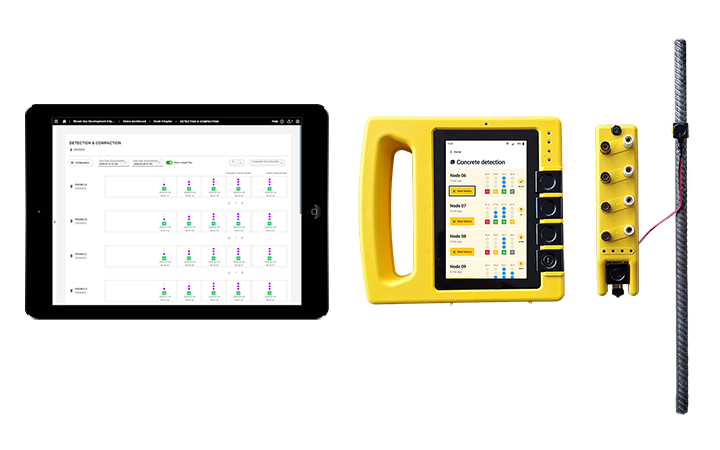
Concrete Detection and Compaction Monitoring

PHONO can be installed at critical locations to indicate when concrete has reached them, turning an assumption about fill progress into a confirmation. In a true SCC application, its relevant role is filling and concrete-presence verification, because conventional mechanical compaction is not part of the SCC concept.
 

From assumptions to live information

Fresh-concrete tests tell you how the SCC behaved when it was sampled; formwork calculations tell you what the pour was designed around. Neither can, by itself, show everything happening inside the formwork once placement is under way.

Pressure, temperature, filling and maturity measurements add direct information from the pour while it is happening. They do not replace the concrete specification, formwork design, acceptance testing or engineering judgement. They help close the gap between what was designed for and what is actually present on site. That gap is usually small. Occasionally it is not and the only way to tell the difference is to look.

There is a second benefit that only shows up later. Each measurement leaves a record and that record is what you reach for when the client, the structural engineer, the insurer or your own team asks why the pour was run the way it was. Documentation of that kind is far easier to have as a by-product of the pour than to reconstruct afterwards.

At Vemaventuri, we believe that is the important shift: from asking only "What did we expect the concrete to do?" to also being able to ask "What is the concrete doing now?"

Vemaventuri Sensor Solution

Key Takeaways

  • SCC's high flowability makes formwork pressure and placement behaviour especially important; pressure also depends on how long the concrete underneath has been at rest.
  • Rate of rise is based on assumed conditions; it is an operating parameter, not a universal SCC speed limit.
  • Concrete temperature can change pressure behaviour and may differ from the design assumption. "Warmer means less pressure" is unreliable as a rule of thumb.
  • Slower is not automatically safer: long interruptions can affect continuity and interlayer bond.
  • In hidden zones, filling cannot be confirmed by eye. A void is normally discovered when the formwork comes off, which is the most expensive moment to find it.
  • Designing for full hydrostatic pressure is safe but costly; knowing how a specific mix behaves allows design against evidence.
  • Fresh-concrete testing remains essential, while real-time monitoring adds visibility once the concrete is inside the structure.

Because with self-compacting concrete, time is not just part of the programme. It is part of the material behaviour. 


References & Standards

  • DIN 18218:2010-01. Fresh concrete pressure on vertical formwork.

  • EN 206, EN 13670 and EN 12350-8 to -12. Concrete: specification, execution and testing of fresh concrete.

  • ACI PRC-237.2-21. Form Pressure Exerted by Self-Consolidating Concrete. American Concrete Institute.

  • EFNARC / European SCC Project Group (2005). The European Guidelines for Self-Compacting Concrete.

  • Megid, W.A. & Khayat, K.H. Work on interlayer bond in multilayer casting of self-consolidating concrete.

  • Proske, T. & Khayat, K.H. (2005). Effect of casting rate and concrete temperature on formwork lateral pressure of SCC. Materials and Structures 38.

Curious about concrete performnce monitoring?

We will present the Vemaventuri solution to you in a 20-minute online demo without any obligation.