

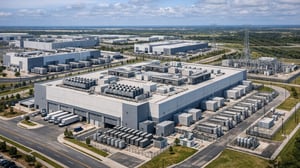
Smarter Concrete Control for Data Center Construction
Ensuring Performance, Program Certainty, and Durability
Data center construction is defined by scale, speed, and very limited tolerance for error. Large concrete substructures must be delivered within compressed schedules, while meeting strict requirements for durability, watertightness, and long-term performance. At the same time, these projects are often executed across complex supply chains and large, distributed site teams, where maintaining consistency in concrete quality and execution becomes increasingly challenging.
In this environment, the margin for uncertainty is small. Delays in construction sequencing, variability in material quality, or undetected defects in execution can have a direct impact on both costs and long-term performance. As a result, the way concrete is managed during placement and early curing plays a critical role in overall project success.
The challenge: limited visibility during construction
Despite the importance of concrete performance, many decisions on site are still based on experience, assumptions, and delayed test results. While this approach has been sufficient in traditional construction, it becomes increasingly restrictive in the context of fast-paced, high-value infrastructure such as data centers.
Typical challenges arise from the combination of large volumes, complex geometries, and strict performance requirements. Basement structures and one-sided walls introduce uncertainty in fresh concrete pressure during placement, particularly when pouring against piles or retaining systems. Thick slabs and foundation elements generate significant heat during hydration, making thermal gradients and cracking a key concern. At the same time, waterproofing requirements demand a high level of consistency in mix quality and execution.
These factors create a situation where contractors must balance productivity with risk. Conservative assumptions can slow down construction, while insufficient control can lead to defects that are difficult to detect and costly to address later.
A shift toward real-time understanding
To overcome these limitations, construction practices are evolving toward a more data-driven approach. Instead of relying on assumptions or post-pour verification, key parameters can now be measured directly during placement and early curing. This shift introduces a continuous understanding of concrete behavior, allowing decisions to be based on actual conditions rather than estimates.
With real-time insight, concrete is no longer treated as a process that can only be verified after the fact. Instead, it becomes something that can be actively managed and optimized throughout execution.
Connecting the concrete process
A comprehensive monitoring approach provides visibility across the entire concrete process, from delivery of the material to its behavior after placement. Instead of isolated measurements, the process is supported by a set of integrated solutions addressing each critical phase of execution.
At the point of delivery, systems such as SONO Hub allow verification of key mix parameters, helping to ensure that each batch meets the intended performance requirements. Variations in water content or consistency can be identified immediately, reducing the risk of inconsistencies that would otherwise affect strength development, durability, and thermal behavior.
During placement, solutions like PREMO introduce a new level of control by monitoring fresh concrete pressure in real time. This is particularly relevant in challenging geometries such as tall or one-sided walls, where behavior is difficult to predict. Instead of relying on conservative assumptions, contractors can adjust pouring rates based on measured conditions, improving both safety and efficiency.
Following placement, TEMO provides continuous insight into temperature development inside the structure. By tracking peak temperatures and cooling behavior, project teams can better manage thermal gradients and reduce the risk of cracking. At the same time, strength development can be derived from real-time data, supporting more informed decisions on striking, loading, and construction sequencing.
In areas where verification is difficult, PHONO enables confirmation of proper compaction and concrete presence, helping to identify potential defects in congested or hard-to-access zones before they become critical.
An important aspect of this approach is that it does not rely on permanently embedded transmitting devices within the concrete. Measurement solutions are designed to provide reliable data during construction without leaving active electronics behind in the structure, supporting both sustainability considerations and long-term asset integrity.
From reactive control to proactive construction
The introduction of real-time data fundamentally changes the way construction teams manage risk. Instead of reacting to issues once they are visible, teams gain the ability to identify deviations early and adjust accordingly.
This has a direct impact on productivity. Decisions on formwork removal, construction sequencing, and reuse can be made with greater confidence, reducing unnecessary waiting times. Pouring strategies can be optimized without compromising safety, and variability in material quality can be managed more effectively.
At the same time, continuous monitoring supports a higher level of quality assurance. Objective data provides transparency throughout the construction process, creating a reliable basis for documentation, compliance, and handover.
Enabling consistent performance at scale
As data center construction continues to expand globally, projects are becoming more standardized while operating under increasing time pressure. This creates a need for construction methods that are not only efficient, but also repeatable and predictable.
Real-time concrete monitoring supports this transition by providing consistent insight across multiple pours, phases, and project locations. Teams can replicate successful processes, identify deviations early, and maintain quality across large-scale operations.
In this way, data does not replace experience, but reinforces it. Site teams can combine practical knowledge with measurable information, resulting in better-informed decisions and more consistent outcomes.
Conclusion
Concrete remains one of the most critical—and least visible—elements in data center construction. As projects become faster and more complex, relying solely on traditional methods of control introduces unnecessary risk and inefficiency.
By making concrete behavior visible in real time, construction teams can move from assumption-based planning to data-driven execution. This enables faster decision-making, improved quality, and greater confidence throughout the construction process.
Ultimately, the ability to understand and control concrete as it is placed and cured is a key factor in delivering data center projects that meet both performance expectations and demanding timelines.
See smart monitoring in action
We will walk you through a live demo of the monitoring system in 20 minutes — no obligation.